
I’ve sat in board meetings where an executive proudly presented a forty-slide deck and called it a strategy.
It wasn’t a strategy. It was a plan with better fonts.
That mix-up — strategy vs plan — is one of the most expensive mistakes I’ve watched leadership teams make.
It doesn’t show up immediately. It shows up six months later, when everyone’s busy but nobody’s winning.
After running marketing organizations through several growth stages, I’ve learned this: confusing the two doesn’t just slow you down. It actively misallocates your best people and your scarcest budget.
Why Strategy and Plans Get Treated Like Synonyms
Most teams default to planning because planning feels productive.
You get a timeline. You get owners. You get a sense of motion.
Strategy is slower. It asks uncomfortable questions before any activity starts.
Who are we for? What will we say no to? Where’s our actual edge?
Skip that thinking, and your plan inherits the gap. You end up with a roadmap and no destination.
What Strategy Is Actually Built On
The 5M Lens
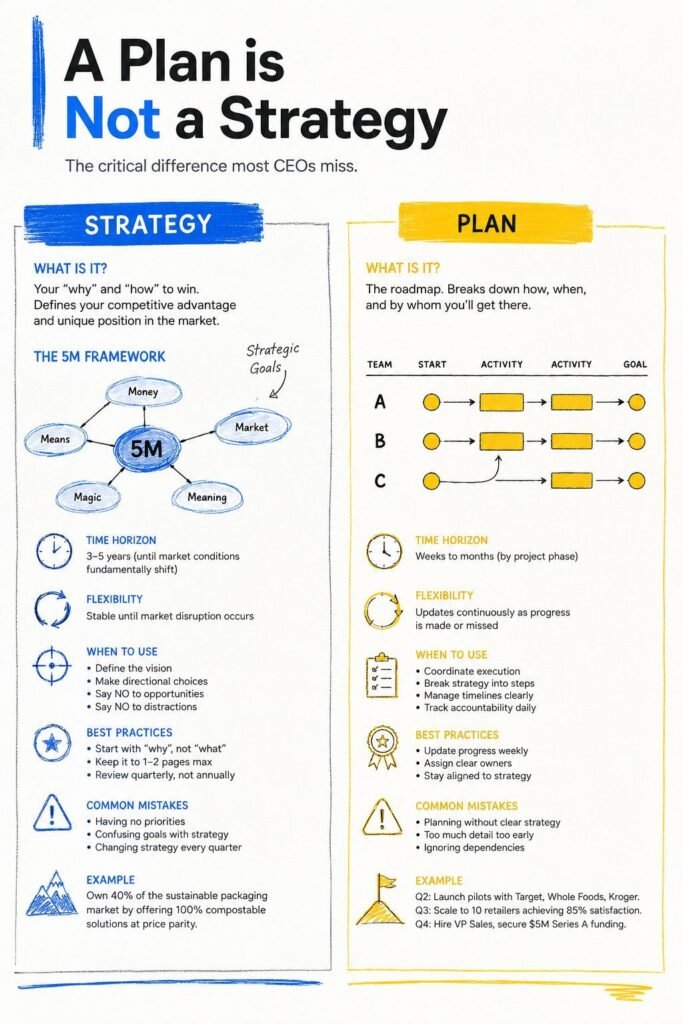
I like frameworks that force discipline, and the 5M model does exactly that — Money, Means, Market, Magic, Meaning.
Each “M” works as a forcing function. Money asks where margin really comes from. Market asks who you’re fighting for. Magic asks what makes you hard to copy. Meaning asks why your team should care past this quarter.
A real strategy answers all five before a single campaign gets built.
Notice the time horizon too: three to five years, stable until market conditions genuinely shift underneath you.
That stability is the point. Strategy isn’t meant to flex every time a competitor makes noise.
What a Plan Is Actually For
A plan has a completely different job. It exists to coordinate, not to differentiate.
Teams, timelines, owners, dependencies — a plan turns strategic intent into Tuesday-morning tasks.
That’s why good plans update weekly. Reality moves faster than vision does.
This is where execution either compounds or collapses. If your plan has clear owners and clean handoffs between teams, momentum builds fast.
If it doesn’t, you get the classic symptom: Team A finishes its activity while Team B is still waiting on an input nobody flagged in week one.
Where the Strategy vs Plan Confusion Actually Hurts
Here’s the pattern I’ve seen wreck otherwise sharp teams.
Leadership treats quarterly OKRs as strategy. They get reviewed, debated, occasionally rewritten — every single quarter.
That’s not strategic discipline. That’s strategy whiplash wearing a planning calendar.
If you’re rewriting your “why” every ninety days, you never had a strategy. You had a series of plans pretending to be one.
The opposite failure is just as common. Founders write a beautiful five-year vision and never break it into anything executable.
Inspiring slide. Zero accountability. Nothing ships.
A Real-World Example Worth Stealing
A strategy built around owning 40% of the sustainable packaging market, through fully compostable solutions at price parity, is a good model to study.
That’s a market position, not a task list.
The plan underneath it is concrete and dated: pilot with major retailers in Q2, scale to ten retailers at 85% satisfaction by Q3, hire a VP of Sales and close Series A funding by Q4.
Same vision, two completely different documents, two completely different review rhythms.
Why This Distinction Matters Most in Marketing
Marketing leaders feel this confusion harder than most functions, because campaigns are visible and strategy isn’t.
A campaign calendar looks like progress. Stakeholders can see it, screenshot it, react to it.
A positioning decision is invisible until it either lands with the right audience or quietly misses them for two years straight.
I’ve watched marketing teams ship flawless campaigns against the wrong audience insight, simply because nobody had locked the strategic “who” before the planning sprint started.
Audience psychology doesn’t reward tactical polish. It rewards relevance, and relevance is a strategy output, not a planning output.
How I Keep These Two Honest on My Own Teams
I run a simple gut check before any planning session starts: can I explain our strategy without mentioning a single tactic?
If I can’t, we don’t have a strategy yet. We have a backlog with ambition.
I also protect the strategy document from scope creep. One to two pages, reviewed quarterly, no exceptions.
The moment a strategy document grows past two pages, it’s usually trying to be a plan — and failing at both jobs.
Plans, on the other hand, I want messy and current. Weekly updates. Named owners. No vague accountability.
A plan that hasn’t changed in three weeks isn’t stable. It’s probably being ignored.
The Leadership Discipline Nobody Talks About
Saying no is strategy. Saying when is planning.
The CEOs who get this wrong aren’t lacking intelligence. They’re avoiding the discomfort of commitment.
A clear strategy closes doors. Some leaders would rather keep every door open and call the resulting chaos “agility.”
It isn’t agility. It’s avoidance with better branding.
The teams that consistently outgrow their competitors aren’t the ones with the flashiest plans.
They’re the ones whose leadership made hard strategic calls early, then let their plans flex hard underneath that fixed point.
That order matters more than most executives think. Strategy first, flexibility second. Reverse it, and you’re just busy.