
In my fifteen-plus years steering marketing teams through rapid growth, acquisitions, and market shifts, I’ve learned one truth the hard way: company culture is rarely what executives believe it to be. The colorful infographic in front of us captures this disconnect perfectly — contrasting the superficial elements people often associate with culture against the deeper, often invisible forces that actually define it.
As a senior marketing director, I’ve watched organizations pour resources into ping-pong tables and generous benefits packages, only to wonder why talent drains away or innovation stalls. The illustration nails it. One pie chart represents the comforting illusion, the other the sometimes uncomfortable reality. This isn’t just an HR issue. In marketing, where consumer behavior, brand perception, and team creativity intersect daily, getting company culture right determines whether your brand story lands authentically or feels hollow.
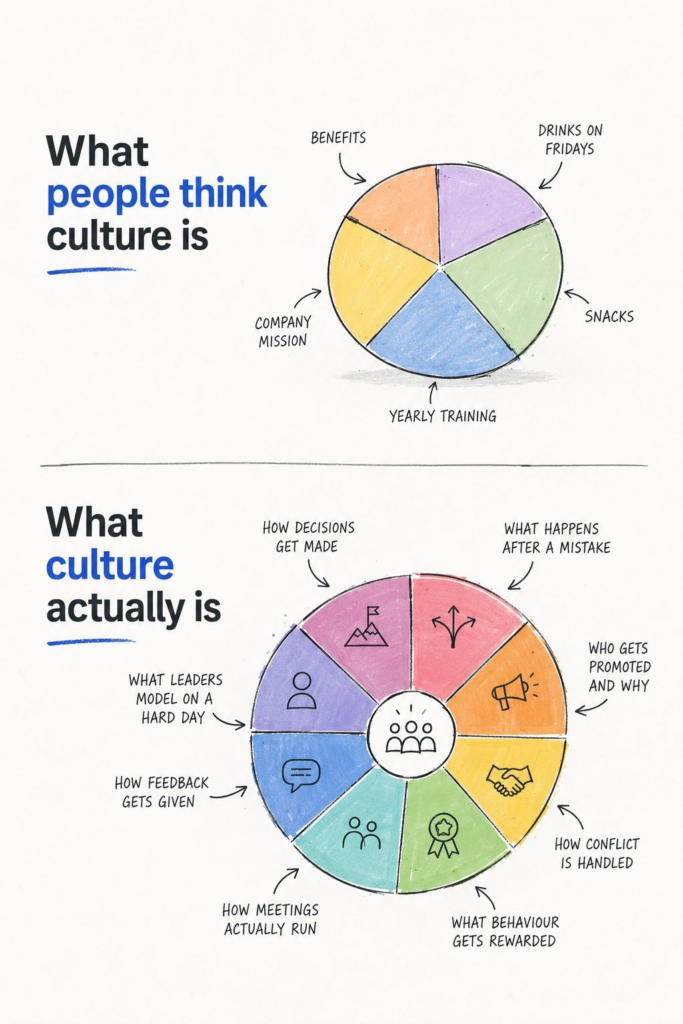
What people think company culture is centers on visible perks: benefits, Friday drinks, snacks, the company mission statement, and annual training sessions. What company culture actually is? It’s the daily patterns — how decisions get made under pressure, how leaders behave on tough days, and which behaviors earn promotion. These patterns shape everything from campaign execution to customer experience. I’ve seen this play out across multiple industries, and the implications for marketing leaders are profound.
The Perks Illusion: Why Surface-Level Thinking Persists
Early in my career, I fell into the same trap. We celebrated “culture wins” like team happy hours and swag drops, convinced these built loyalty. The top chart in the infographic reflects this common mindset — company culture reduced to transactional benefits and occasional feel-good activities. It’s understandable. Perks are easy to measure, photograph for social media, and include in recruiting decks.
Yet in practice, these elements rarely drive sustained performance. I’ve led campaigns where teams with mediocre benefits outperformed those with lavish ones because the former had clearer decision-making processes. Consumer behavior research consistently shows people connect with brands that feel genuine. The same principle applies internally. When employees sense a gap between stated values and daily reality, cynicism spreads faster than any internal memo can contain.
From a strategic perspective, over-focusing on perks signals shallow brand thinking. Marketing teams excel when they understand audience psychology deeply. The same insight applies to internal audiences. Employees aren’t motivated long-term by snacks or training slides. They watch how conflict gets resolved after a failed product launch or who gets recognized after a big win. These observations form their perception of company culture far more powerfully than any benefits brochure.
Decoding Real Company Culture: The Behavioral Core
The bottom pie chart shifts our focus to what actually matters. It highlights critical dimensions: how decisions get made, what happens after mistakes, who gets promoted and why, how feedback flows, how meetings run, what behaviors get rewarded, how conflict is handled, and what leaders model during challenges.
In my experience, these elements form the true operating system of any organization. Take decision-making, for instance. In high-performing marketing teams I’ve built, decisions weren’t bottlenecked at the top. Instead, clear frameworks empowered specialists closest to the data — whether campaign metrics or customer insights — to move quickly. This agility translated directly to faster market responses and more innovative campaigns.
Contrast that with environments where every choice requires multiple approvals. The result? Missed opportunities and frustrated talent. I’ve witnessed this pattern repeatedly: organizations claiming innovative cultures but punishing risk through their promotion criteria. The infographic’s segment on “who gets promoted and why” is particularly telling. In marketing, we often talk about rewarding creativity, yet many companies still promote conformity and political navigation over bold thinking.
One pattern I’ve consistently observed across performance campaigns is that recognition systems reveal true priorities. When “what behaviour gets rewarded” favors execution over experimentation, teams optimize for safe, incremental gains rather than breakthrough ideas. As marketing leaders, we must audit these reward structures regularly. They influence not just retention but the quality of work produced.
Leadership Behavior: The Most Visible Signal
Perhaps the most insightful part of the infographic is the slice about “what leaders model on a hard day.” This cuts to the heart of authentic company culture. In moments of crisis — a campaign flop, market downturn, or internal conflict — leadership behavior becomes the ultimate teacher.
I’ve been in rooms where executives preached resilience but panicked visibly when metrics dipped. The team absorbed the lesson: safety first, innovation second. Conversely, leaders who maintained strategic calm while addressing issues head-on built cultures where calculated risks became the norm. This modeling effect ripples through everything from creative brainstorming to customer service interactions.
Feedback mechanisms represent another crucial area. Superficial cultures treat feedback as annual reviews or generic surveys. Real company culture integrates it as continuous, specific, and action-oriented dialogue. In marketing, where testing and iteration define success, poor feedback loops kill campaigns before they launch. I’ve implemented real-time feedback systems that transformed team output, proving that how feedback gets given matters more than any training module.
The Meeting Reality and Conflict Dynamics
How meetings actually run often exposes cultural truth. The infographic rightly calls this out. Too many organizations fill calendars with status updates that could be emails, leaving little space for strategic discussion. In effective marketing teams, meetings become decision forums where diverse perspectives challenge assumptions and refine ideas.
I’ve made it a practice to redesign meeting cadences when joining new organizations. The difference in energy and output is remarkable. When meetings focus on problem-solving rather than reporting, company culture shifts toward action and accountability.
Conflict handling reveals even more. Healthy cultures don’t avoid tension — they channel it productively. In marketing, where creative differences drive better work, suppressing dissent leads to mediocre campaigns that please everyone but excite no one. I’ve seen teams transform by normalizing constructive debate while maintaining respect. The result? Stronger strategies and higher team satisfaction.
What happens after a mistake often determines innovation appetite. Organizations that punish failure publicly while rewarding it privately create fear-based cultures. Marketing, by nature experimental, suffers terribly here. The brands that win long-term view mistakes as data points. In my leadership journey, normalizing post-mortems focused on learning rather than blame has unlocked significant creative potential.
Strategic Implications for Marketing Leaders
As someone responsible for brand positioning and growth, I’ve come to see company culture as a core marketing asset. External brand promises must align with internal realities, or authenticity gaps emerge that consumers quickly detect.
The infographic’s contrast challenges us to audit our organizations honestly. Start with promotion criteria: do they truly reward behaviors aligned with strategic goals? Examine decision rights: are they distributed according to expertise? Most importantly, observe leadership behavior under stress — it rarely lies.
In today’s talent market, especially for creative and analytical roles in marketing, candidates evaluate these realities during interviews and early tenure. Perks might attract them, but behavioral patterns determine whether they stay and thrive.
Building Authentic Company Culture: A Marketing Approach
Treating culture-building like a marketing campaign has served me well. Define your audience (employees), understand their needs and motivations, craft consistent messaging through actions, and measure results through engagement and output.
Focus first on the “what behaviour gets rewarded” dimension. Align recognition systems with desired outcomes. In marketing teams, this might mean celebrating well-executed tests that yield insights, even if the campaign didn’t convert as hoped.
Invest in leadership development that emphasizes modeling desired behaviors. I’ve facilitated sessions where executives practiced responses to common challenges, reinforcing cultural principles through repetition.
Regularly examine how conflict is handled and feedback given. Implement structures that make these processes predictable and fair. The payoff appears in higher innovation rates and stronger employer branding — crucial for attracting top marketing talent.
Conclusion
The infographic brilliantly distills a complex truth I’ve lived throughout my career: company culture isn’t what we say or showcase in recruiting materials. It’s the accumulated patterns of behavior, decision-making, and recognition that define daily experience.
As marketing leaders, we have both the insight and responsibility to bridge this gap. By focusing on the real elements highlighted — from promotion logic to mistake recovery — we create environments where authentic brands emerge naturally. The organizations that understand this don’t just retain talent better; they build cultures that amplify their market impact.
In an era where consumers demand transparency and employees seek purpose, getting company culture right isn’t optional. It’s a strategic imperative. The next time someone mentions Friday drinks as evidence of strong culture, remember the deeper chart. True competitive advantage comes from aligning what we claim with what we actually live. That’s the kind of company culture worth building — and marketing.