
I’ve sat in enough product review meetings to know the exact moment a good idea dies.
Someone says, “that’s not how we do things here.”
Steve Jobs built an entire company by refusing to accept that sentence as an answer.
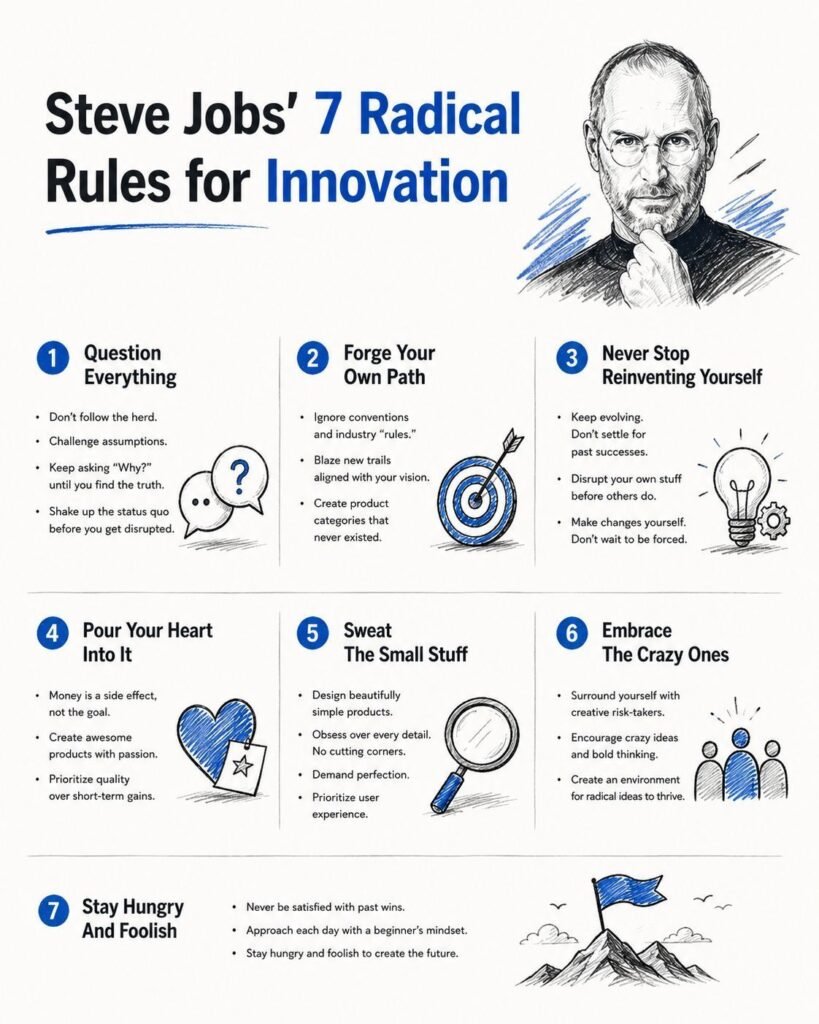
The seven principles in this infographic aren’t motivational posters. They’re operating rules. I’ve watched them separate category leaders from companies that quietly faded into the background.
Steve Jobs’ rules for innovation hold up because they were never about personality. They were about decisions, repeated under pressure.
Here’s what each one actually means once you’re the one running budgets, teams, and deadlines.
Question Everything: The Discipline Most Teams Skip
Most marketing teams ask “what’s working” before they ask “why.”
Jobs reversed that order. He pushed past comfortable assumptions until he hit the real problem underneath them.
In my experience, marketing departments love best practices. We benchmark competitors. We recycle formats that worked three years ago because they’re familiar.
That’s safe. It’s also how strong brands slowly become invisible.
Questioning everything isn’t rebellion for its own sake. It’s a filter. If you can’t explain why a tactic still makes sense today, you probably shouldn’t be running it again.
Forge Your Own Path: Positioning Before Promotion
This is where most companies confuse imitation with strategy.
Jobs didn’t study the PC industry to fit into it better. He built products that made the existing category look outdated by comparison.
That’s positioning, not promotion. Promotion amplifies a message. Positioning decides what message is worth amplifying in the first place.
When I advise teams on go-to-market plans, my first question isn’t “how do we beat competitor X.” It’s “do we even need to compete on their terms, or are we solving a different problem entirely.”
Most breakthrough brands chose the second path.
Never Stop Reinventing Yourself: The Cost of Staying Comfortable
This rule is uncomfortable for big companies on purpose.
Disrupting your own product before a competitor does it for you is expensive, awkward, and internally unpopular. Sales resists it. Finance resists it. Boards resist it.
Jobs did it anyway, more than once.
I’ve sat through budget meetings where protecting last year’s win mattered more than funding next year’s advantage. That instinct feels rational in the moment. It’s a slow leak over time.
Reinvention can’t be a campaign theme. It needs to be a recurring agenda item, reviewed with the same seriousness as revenue targets.
Pour Your Heart Into It: Passion Shows Up in the Margins
“Money is a side effect, not the goal” is easy to admire and harder to apply when there’s a quarterly number attached to your name.
Budgets exist. Targets exist. Nobody gets to ignore them.
But here’s what I’ve noticed running creative teams: passion shows up in the decisions nobody is tracking. The extra round of copy edits. The slightly more deliberate font choice. The onboarding email that didn’t have to be that thoughtful.
Customers feel that difference even when they can’t name it.
Sweat the Small Stuff: Where Brand Trust Gets Built
Obsessing over detail sounds like a design principle. It’s actually a trust mechanism.
Every shortcut a team takes is a small bet that nobody will notice. Most of the time, nobody does. Occasionally someone does, and that’s exactly when trust erodes.
Demanding perfection doesn’t mean chasing flawlessness everywhere, equally. It means deciding which details are non-negotiable for your brand and protecting those without exception, even when the deadline says otherwise.
Embrace the Crazy Ones: Building Rooms Where Risk Survives
This is the rule most executives underrate.
Creative risk-takers don’t thrive by accident. They thrive inside environments specifically built to protect strange-sounding ideas long enough to test them.
Most organizations say they want bold thinking. Far fewer build the psychological safety required for someone to pitch something genuinely odd in a room full of senior leaders.
I’ve learned that the strongest campaigns I’ve shipped almost never survived their first internal pitch unchanged. They survived because someone protected them past that meeting, not because the idea arrived perfect.
Stay Hungry and Foolish: The Mindset That Outlasts the Win
The last rule is the simplest to say and the hardest to sustain.
A beginner’s mindset comes easily after failure. It’s nearly impossible after a major win.
Success creates its own gravity. Teams start protecting what worked instead of questioning what’s next.
The brands that keep growing treat their last win as data, not as identity.
That distinction sounds small. It’s the entire difference between a company that’s still building and one that’s coasting on a logo people used to be excited about.
Jobs’ seven rules for innovation don’t describe a personality you either have or don’t. They describe a set of decisions, made again and again, long after the applause for the first good idea has faded.
That’s the part most companies skip.