
In my experience as Senior Marketing Director, I’ve watched talented teams miss deadlines not because of lack of skill, but because of fragmented attention and unclear next steps. The difference between good intentions and outstanding results often comes down to systems that enforce clarity. That’s where planner effectiveness stands out as more than a personal habit — it’s a strategic multiplier.
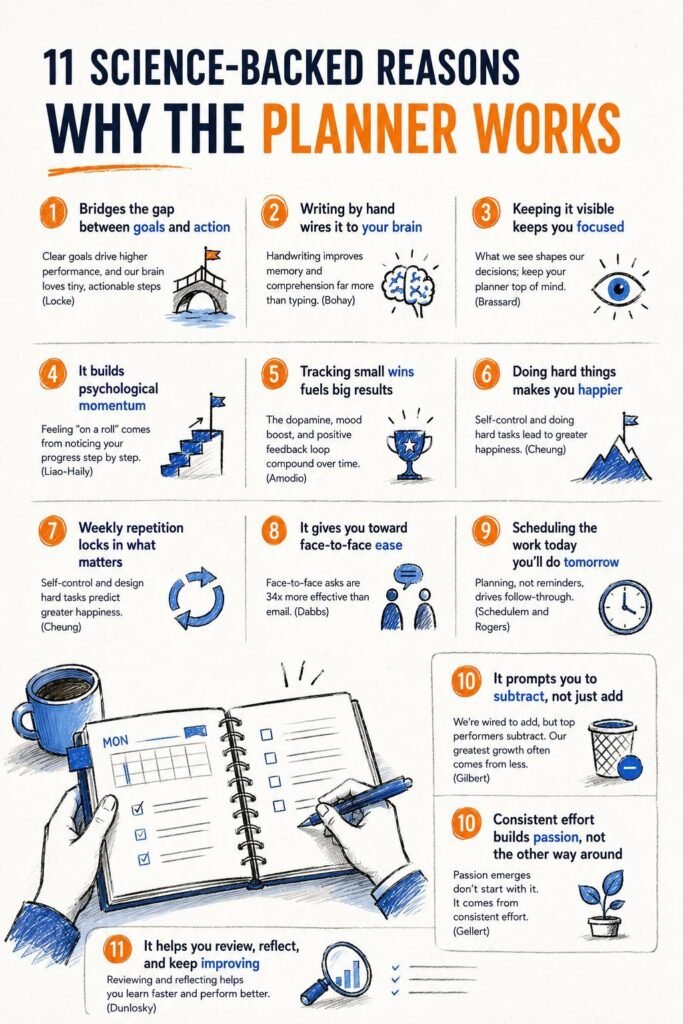
Looking at this compelling infographic on 11 science-backed reasons why the planner works, I’m reminded of patterns I’ve observed across high-performing marketing organizations. Planner effectiveness isn’t about aesthetics or trendy stationery. It’s about leveraging proven psychological mechanisms to close the gap between strategy and execution. In a world of constant digital distraction, the physical planner creates a focused space that digital tools rarely match.
As someone who’s scaled campaigns and built teams under tight deadlines, I can attest that planner effectiveness compounds over time. It shapes not just what we do, but how we think about our work. Let’s break down these insights with the practical lens of someone who’s led marketing initiatives where every day counts.
The Psychological Foundation of Planner Effectiveness
Bridging Goals and Action
The first reason highlighted — bridging the gap between goals and action — resonates deeply with my leadership philosophy. Clear, actionable steps aren’t just motivational fluff; research by Locke shows they drive measurably higher performance. Our brains crave tiny, achievable tasks because they reduce cognitive load and create immediate momentum.
In marketing campaigns I’ve directed, teams that broke big objectives into daily planner entries consistently outperformed those relying on vague quarterly goals. Planner effectiveness here acts as a translation layer, turning high-level strategy into executable micro-actions. Without this bridge, even the best ideas remain trapped in slides and spreadsheets.
Handwriting and Cognitive Wiring
Point two emphasizes how writing by hand wires goals to your brain more effectively than typing. This isn’t nostalgia — it’s neuroscience. Studies like Bohay’s demonstrate superior memory retention and comprehension through handwriting.
I’ve personally experienced this when mapping out complex launch timelines. The act of physically writing forces deeper processing. In team settings, encouraging planner use for key initiatives creates shared cognitive ownership. Planner effectiveness gains strength through this tactile engagement, making abstract targets feel concrete and personal.
Visibility Drives Focus
Keeping the planner visible, as noted in the third point citing Brassard, fundamentally shapes decision-making. What we see repeatedly influences our priorities. In open office environments or hybrid setups I’ve managed, team members with visible planners naturally aligned their conversations around shared progress.
This visibility creates a constant, gentle reminder system that digital notifications often fail to replicate due to notification fatigue. Planner effectiveness leverages our visual processing strengths to maintain focus amid competing demands.
Building Momentum Through Small Wins
Psychological Momentum and Dopamine Loops
Points four and five explore how noticing progress builds psychological momentum and how tracking small wins fuels bigger results. Liao-Haily and Amodio’s referenced research aligns perfectly with real-world observations. The dopamine boost from visible checkmarks creates a positive feedback loop that’s particularly valuable in long-cycle marketing projects.
I’ve seen this in content calendar management. Teams that logged daily wins in their planners maintained higher energy through extended campaigns. Planner effectiveness turns abstract progress into tangible evidence, combating the demotivation that creeps into complex initiatives.
The Happiness Factor in Hard Tasks
Point six links doing hard things to greater happiness through self-control. Cheung’s insights here challenge the common assumption that ease equals fulfillment. In marketing leadership, the most rewarding work often involves navigating uncertainty and pushing creative boundaries.
Planner effectiveness supports this by providing structure for tackling challenging tasks. When teams schedule difficult strategic work first, they experience the satisfaction of mastery rather than the drain of avoidance. This has profound implications for team morale and retention.
Repetition, Relationships, and Forward Planning
Weekly Repetition and Habit Formation
Weekly repetition locking in what matters, per point seven, underscores the power of consistent practice. Self-control paired with deliberate design predicts greater happiness. In my career, I’ve implemented weekly planner reviews as non-negotiable team rituals. These sessions reveal patterns that quarterly reviews miss.
Planner effectiveness emerges strongly through this cadence. It transforms sporadic effort into reliable systems that scale beyond individual discipline.
Communication Advantages
The eighth reason highlights how planning supports face-to-face interactions, which Dabb’s research shows are 34 times more effective than email. In an increasingly digital marketing landscape, this reminder is crucial. Planners that prepare us for meaningful conversations elevate relationship-building, a cornerstone of successful campaigns and stakeholder management.
Preemptive Scheduling
Point nine on scheduling today’s work for tomorrow’s ease, referencing Rogers and others, addresses a common planning pitfall. Planning, not just reminding, drives follow-through. This forward-thinking approach has saved numerous launch timelines in my experience by surfacing potential bottlenecks early.
Advanced Strategies in Planner Effectiveness
Subtraction Over Addition
The tenth point on subtracting rather than just adding is particularly insightful. Gilbert’s observation that top performers subtract resonates with my approach to campaign optimization. We’re wired to accumulate, yet greatest growth comes from focus and elimination.
In marketing strategy sessions, I’ve guided teams to use planners not just for task addition but for deliberate removal of low-value activities. This creates space for high-impact work. Planner effectiveness includes this pruning capability, preventing the bloat that kills productivity.
Passion Through Consistent Effort
Also under point ten, Geller’s insight that consistent effort builds passion rather than the reverse is a game-changer. Many professionals wait for motivation that rarely arrives without structure. Planner effectiveness provides the framework where passion can emerge organically through repeated, focused action.
Review, Reflect, and Improve
The final point on reviewing and reflecting for continuous improvement, citing Dunlosky, ties everything together. Learning accelerates when we analyze what worked and what didn’t. In post-campaign debriefs, teams using structured planner reviews generate more actionable insights.
Conclusion
After examining these 11 science-backed reasons, planner effectiveness clearly extends far beyond simple time management. It represents a comprehensive system for cognitive alignment, momentum building, and strategic execution. In my leadership journey, adopting and championing these principles has consistently delivered superior results across marketing teams.
The beauty lies in its accessibility. No expensive software required — just consistent, intentional use of a tool that leverages how our brains actually function. As marketing professionals face increasing complexity and information overload, planner effectiveness offers a grounded counterbalance.
Moving forward, I encourage every leader to experiment with these insights. Integrate them into your routines and observe the compound effect on both personal output and team performance. In a field where adaptability and clarity determine success, the planner remains one of the most powerful, evidence-based tools available. The science is clear. The question is whether we’ll commit to the practice.