
Most marketing fails before the campaign even launches.
Not because the budget was wrong. Not because the creative was weak. Because there was no real strategy behind it — just tactics dressed up as a plan.
The chess metaphor in this infographic isn’t decorative. It’s precise. Chess rewards positional thinking, patience, and the ability to anticipate what your audience will do next. Marketing mastery strategy works the same way.
Let me walk you through what this framework actually means for practitioners.
The Three Stages Nobody Treats as a System
Every marketer talks about the funnel. Almost nobody builds it as a connected system.
The infographic breaks the game into three phases: Awareness, Conversion, and Retention. Simple enough. But the insight here isn’t the labels — it’s the sequencing. Each phase has its own psychological logic, and skipping steps is where most campaigns fall apart.
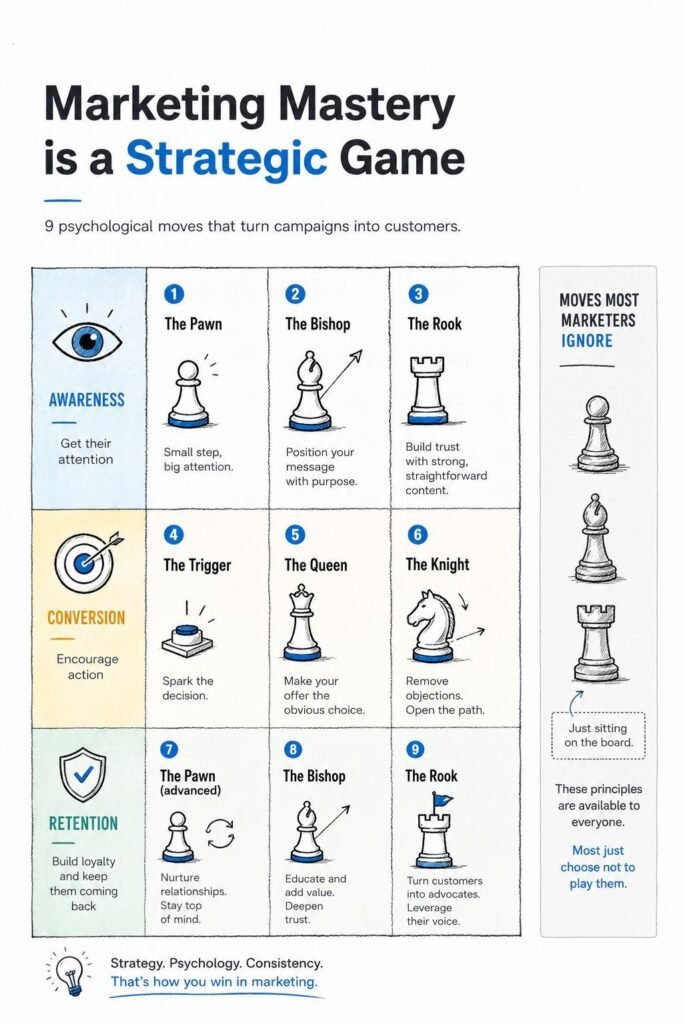
Awareness isn’t just reach. Conversion isn’t just a button. Retention isn’t just an email drip.
They’re distinct mindsets. And each requires a different move.
Awareness: Playing the Opening
The Pawn — Small Step, Big Attention
The Pawn is chronically underestimated. In chess and in marketing.
A single, simple message placed in front of the right person at the right moment can outperform a complex multichannel push. I’ve seen brands with modest budgets outmaneuver well-funded competitors simply by being consistent with one clear, small idea repeated well.
Don’t overlook the Pawn. It’s often your first impression.
The Bishop — Positioning With Purpose
Positioning isn’t a tagline exercise. It’s a deliberate choice about what angle you occupy in your audience’s mind.
The Bishop moves diagonally — always at an angle, always with direction. Your messaging should work the same way. Not straight-line obvious. Intentional and distinct.
The Rook — Trust Through Clarity
Straightforward content builds trust faster than clever content.
The Rook is linear, powerful, and reliable. Brands that consistently deliver clear, honest communication earn credibility that no paid media can replicate. Trust is the only awareness metric that compounds over time.
Conversion: Forcing the Decision
This is where most marketing budgets live — and where most money gets wasted.
The Trigger — Sparking the Decision
A trigger isn’t a discount. It’s a psychological prompt that makes inaction feel uncomfortable.
Urgency, social proof, framing, loss aversion — these are triggers. The best ones don’t feel manipulative because they’re aligned with something the buyer already wants. The Trigger in a marketing mastery strategy doesn’t create desire. It activates it.
The Queen — Making Your Offer the Obvious Choice
The Queen is the most powerful piece on the board. Your offer, when constructed correctly, should feel the same way.
This isn’t about being the cheapest or loudest. It’s about making the value proposition so clear that choosing anything else feels like a mistake. The Queen doesn’t beg for attention. She commands it.
The Knight — Removing Objections
The Knight moves in ways that catch people off guard. In marketing terms, that’s objection handling done proactively.
Most brands wait for objections to surface. Smart marketers anticipate them and address them before the prospect even asks. Remove the friction. Open the path. The sale happens in the space between doubt and decision.
Retention: The Endgame Most Brands Forfeit
Acquisition gets the glory. Retention builds the business.
The Advanced Pawn — Nurturing Relationships
An advanced Pawn becomes something entirely different on the board. A customer who feels genuinely nurtured behaves differently too — they return, they refer, they forgive mistakes.
Staying top of mind doesn’t require constant broadcasting. It requires consistent relevance. That’s a meaningful distinction.
The Bishop (Advanced) — Educating and Deepening Trust
Once someone is a customer, the communication goal shifts. Stop selling. Start teaching.
Brands that invest in educating their existing customers deepen the relationship in ways that promotions never can. Value-added content at this stage isn’t a nice-to-have — it’s the mechanism for long-term retention.
The Rook (Advanced) — Turning Customers Into Advocates
This is where the marketing mastery strategy reaches its highest leverage point.
An advocate does your marketing for you. Not because you asked them to, but because you gave them something worth sharing. Peer recommendations carry a credibility multiplier that no ad placement can match. The brands that engineer advocacy — through experience, community, and recognition — compound their growth in ways that paid channels can’t sustain alone.
The Sidebar Nobody Should Ignore
The infographic includes a quiet but pointed observation: these moves are available to everyone. Most just choose not to play them.
That’s not a motivational line. That’s a competitive reality.
The principles behind awareness, conversion, and retention psychology aren’t secret. They’re documented, tested, and accessible. What separates the brands that win is discipline, consistency, and the willingness to think three moves ahead rather than chasing short-term metrics.
What Separates Strategy From Activity
I’ve worked with teams that were extraordinarily busy and completely ineffective. Activity without sequencing isn’t strategy. It’s noise with a budget.
The chess framework works because it forces you to think about position, not just motion. Where are you in the game? What does your audience need right now? What move advances your position — not just for this quarter, but for the next twelve months?
Marketing mastery strategy, at its core, is about making deliberate choices. Every piece has a role. Every move has a consequence. The brands that treat marketing like a strategic game — patient, positional, psychologically informed — tend to be the ones still standing when the dust settles.
The board is set. The question is whether you’re actually playing, or just watching.