
In my experience leading marketing teams at the intersection of tech and B2B, the difference between good campaigns and truly transformative ones often comes down to moments that feel like luck. Yet after years of building strategies, scaling teams, and navigating market shifts, I’ve learned that luck is rarely pure chance. You can create your own luck by understanding its mechanics and deliberately positioning yourself and your brand to capitalize on it.
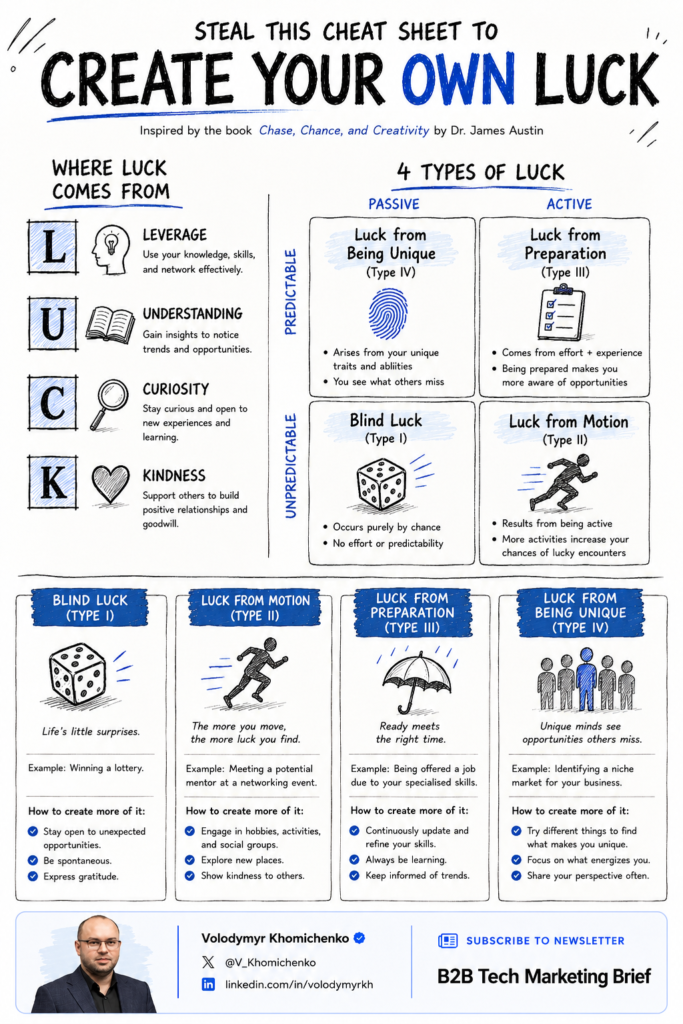
This insight crystallized for me through Dr. James Austin’s framework in Chase, Chance, and Creativity. The infographic we’ve developed distills these ideas into an actionable cheat sheet, blending the LUCK principles—Leverage, Understanding, Curiosity, and Kindness—with four distinct types of luck. For marketing leaders, this isn’t abstract philosophy; it’s a practical playbook for turning unpredictability into competitive advantage. In an era where algorithms change overnight and buyer attention is fragmented, those who master creating their own luck consistently outperform the rest.
Where Luck Comes From: The LUCK Foundation
Every strong marketing motion starts with foundational behaviors. The LUCK acronym captures this beautifully: Leverage your knowledge, skills, and network; build deep Understanding to spot trends others miss; stay driven by Curiosity to remain open to new learning; and practice Kindness to foster relationships that generate goodwill and unexpected opportunities.
From my vantage point running B2B tech marketing, leverage is non-negotiable. It’s not just about what you know but how effectively you deploy it across campaigns, content, and partnerships. I’ve seen teams waste months chasing trends without the underlying network to amplify them. Understanding, meanwhile, separates reactive marketers from strategic ones. When you invest in genuine insight—through customer interviews, data analysis, or simply reading the room—you begin noticing opportunities that feel like luck to others.
Curiosity keeps campaigns fresh. In one product launch I led, our team’s willingness to experiment with unconventional formats led to a breakout channel we hadn’t anticipated. And kindness? Never underestimate it. Supporting peers, sharing credit, and building authentic connections often returns multiplied opportunities down the line. These aren’t soft skills in marketing—they’re force multipliers that make the other types of luck far more likely.
The Four Types of Luck: Passive vs Active, Predictable vs Unpredictable
Dr. Austin’s model divides luck into four types, creating a matrix that’s incredibly relevant for marketing strategy. On one axis you have passive versus active luck; on the other, predictable versus unpredictable. This framework has reshaped how I allocate resources and coach teams.
Blind Luck (Type I): Recognizing Life’s Little Surprises
Blind luck is the classic roll of the dice—pure chance with no effort or predictability. Winning a lottery or stumbling upon an unsolicited inbound lead that converts immediately falls here. In marketing, these moments happen: a viral tweet, an unexpected mention in a major publication, or a competitor’s misstep that opens a window.
Yet here’s the strategic observation I’ve made across campaigns: while you can’t manufacture blind luck, you can increase your surface area for it. Teams that stay open to unexpected opportunities, practice spontaneity, and express gratitude for small wins tend to notice and act on them faster. The key insight? Blind luck favors the prepared mind. I’ve watched passive waiting destroy momentum, while proactive awareness turns random events into catalysts.
Luck from Motion (Type II): The Power of Activity
This is where marketing leadership gets exciting. Luck from motion emerges when you’re actively moving—engaging in hobbies, attending events, exploring new channels, and showing kindness. The more activities you pursue, the higher your chances of lucky encounters.
In practice, this means getting your brand and team in motion. One of the most effective tactics I’ve used is encouraging cross-functional experimentation. When teams attend industry events not just to sell but to genuinely connect, mentor, and explore, serendipitous partnerships form. A casual conversation at a conference once led to a major co-marketing deal that accelerated our pipeline by 40%. The lesson is clear: motion compounds. The runner in the infographic isn’t sprinting aimlessly—he’s increasing probability through deliberate action. As a leader, I now measure team velocity not just by output but by the diversity of experiences they accumulate.
Luck from Preparation (Type III): Ready Meets the Right Time
This is the type of luck I respect most as a senior marketing director. It comes from effort plus experience. By continuously updating skills, learning trends, and refining your craft, you position yourself so that when opportunity knocks, you’re ready.
In B2B tech, preparation looks like deep audience research, iterative A/B testing, and staying ahead of platform changes. I recall a campaign where our team’s ongoing investment in data analytics allowed us to identify a shifting buyer behavior weeks before competitors. The result felt like luck—an incredibly timely offer that resonated perfectly—but it was engineered through preparation. The umbrella icon in the infographic is apt: you create shelter for opportunities by building capability. Marketing leaders who treat skill development as non-negotiable create repeatable luck. In my experience, this type separates sustainable growth from flash-in-the-pan successes.
Luck from Being Unique (Type IV): Unique Minds See Opportunities Others Miss
This is perhaps the most powerful for brand differentiation. Luck from being unique arises from your distinct traits, abilities, and perspectives. When you lean into what makes you and your brand singular, you spot niches and connections others overlook.
In marketing strategy, this translates to owning a unique point of view. Too many brands blend into the noise by following best practices. The winners carve their own lane. For instance, focusing on what truly energizes your team and sharing that authentic perspective builds a community others can’t replicate. The infographic’s illustration of diverse figures highlights this collective uniqueness. In one rebranding effort, our willingness to challenge industry assumptions around buyer journeys not only differentiated us but attracted ideal clients who resonated with our distinct approach. Creating your own luck here means doubling down on authenticity rather than chasing trends.
Integrating the Framework: Practical Marketing Applications
Bringing these types together requires intentional leadership. In my career, I’ve used this model during quarterly planning to audit our activities. Are we creating enough motion? Investing sufficiently in preparation? Celebrating and leveraging our uniqueness?
Consumer behavior today rewards brands that appear “lucky” because they’re consistently present and prepared. Audience psychology shows people gravitate toward entities that seem to attract positive outcomes. This creates a virtuous cycle: motion generates blind luck opportunities, preparation converts them, and uniqueness amplifies their impact.
I’ve applied this in content strategy, where curiosity-driven research leads to unique angles that earn organic shares (motion + uniqueness). In demand generation, preparation through audience segmentation turns average leads into high-quality ones. The business implications are significant—teams operating with this mindset report higher engagement, better retention, and accelerated growth.
Strategic Observations for Marketing Leaders
One pattern I’ve consistently observed is that organizations treating luck as entirely external struggle with resilience. Markets shift, algorithms evolve, economic conditions change. The leaders who thrive are those who build systems for creating their own luck.
Audience psychology plays a crucial role here. Professionals respond to brands that demonstrate agency rather than victimhood to market forces. When your marketing reflects deliberate preparation and authentic uniqueness, trust compounds. I’ve seen this in personal branding too—executives who consistently share insights from a place of curiosity and kindness build networks that deliver ongoing opportunities.
Growth considerations also matter. In resource-constrained environments, focusing on high-leverage activities—those combining preparation with motion—yields disproportionate returns. Campaign logic shifts from hoping for virality to engineering multiple small lucky moments that aggregate into major wins.
Conclusion
Creating your own luck isn’t about denying chance but about maximizing your influence over it. The LUCK framework and four types provide a roadmap that’s as relevant for individual marketers as it is for entire organizations. In my leadership journey, embracing this mindset has been one of the highest-ROI shifts I’ve made—moving from reactive tactics to proactive orchestration of opportunity.
As you review the infographic, challenge yourself: Where can you introduce more motion this quarter? How will you deepen preparation in your weakest area? What makes your brand uniquely positioned to see opportunities others miss? The professionals and teams who internalize these principles don’t just wait for luck—they become the ones others perceive as consistently fortunate.
In the end, that’s the ultimate marketing advantage: positioning your brand so that when the right moment arrives, you’re undeniably ready to seize it. The luck you create today shapes the growth you achieve tomorrow.