
Every manager says they delegate. Most of them just hand off work and hope for the best.
I’ve sat through enough leadership reviews to know the difference. The leaders who scale their impact have a real delegation framework behind every task they hand out. The ones who burn out their teams don’t.
This isn’t about being generous with your calendar. It’s about designing how decisions move through your organization.
Why Most Delegation Fails
Delegation breaks down for one reason: ambiguity.
A manager says “take care of this” and walks away. The employee guesses at scope, deadline, and how much freedom they actually have.
Three weeks later, the work comes back wrong. Not because the person lacked skill. Because nobody defined the rules of engagement.
I made this mistake early in my career. I handed a junior marketer a campaign brief with no clarity on budget approval. She built something genuinely good. It also blew past spend limits I never mentioned.
That’s not her failure. That’s mine.
Why a Delegation Framework Needs Seven Levels, Not One
Most people treat delegation as binary. You either keep control or you give it away.
The 7 Levels of Delegation break that myth apart. Tell, Sell, Consult, Agree, Advise, Inquire, Delegate — each level hands over a different slice of authority.
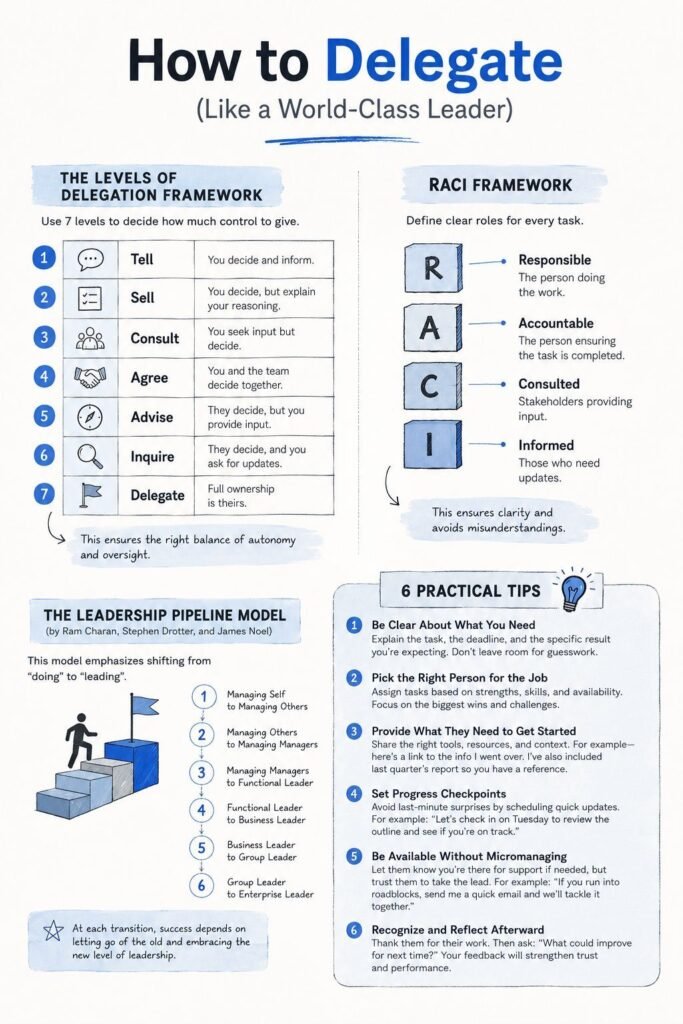
This matters more than it looks. A new hire might only be ready for “Tell.” A seasoned director can run at “Delegate” with zero check-ins.
The mistake I see constantly: leaders apply one level to everyone. Same instructions, same oversight, same script, regardless of who’s on the other end.
A good delegation framework treats authority as a dial, not a switch. You turn it up as trust and competence grow. You turn it down when stakes are high or someone’s new to the task.
RACI Solves the Problem Org Charts Can’t
Job titles tell you what someone’s role is. They don’t tell you who decides what on a specific project.
That gap is where cross-functional work usually goes sideways. Marketing thinks legal owns the call. Legal thinks marketing does. Nobody actually decided.
RACI fixes this with brutal simplicity: Responsible, Accountable, Consulted, Informed. Four labels, one task, zero confusion.
I’ve run product launches where the single highest-leverage move wasn’t a sharper creative brief. It was fifteen minutes spent assigning RACI roles before the work even started.
Accountable is the role people misuse most. It’s not “the boss.” It’s the one person whose name is on the outcome, good or bad. If two people are Accountable for the same deliverable, you don’t have clarity. You have a future argument waiting to happen.
Delegation Is a Leadership Transition, Not a Task
Most management training gets this wrong. It teaches delegation as a skill applied to a checklist.
The Leadership Pipeline Model, from Charan, Drotter, and Noel, frames it differently. Every promotion is really a transition — managing self to managing others, managing managers to leading a function, and onward.
At each step, the job isn’t to delegate more tasks. It’s to fully let go of the previous job.
I watched a VP get stuck for two years because she kept doing the director-level work she’d mastered, instead of releasing it. Her team was capable. She just couldn’t put the wheel down.
A delegation framework only works if the leader using it has made that internal shift first. Tools don’t fix an unwillingness to let go.
The Tactical Layer: Six Habits That Make It Stick
Frameworks set the structure. Habits make it real on a Tuesday afternoon.
The six practical tips here look simple. They’re also the ones I see skipped constantly.
Be specific about the task, deadline, and outcome. Vague instructions produce vague results.
Match the assignment to the right strengths, not just whoever’s free.
Hand over context and resources up front, not in a follow-up email three days later.
Set checkpoints before problems happen, not after.
Stay reachable without hovering. Support isn’t supervision.
Close the loop with a real conversation afterward, not just a thank-you.
That last one gets ignored the most. Leaders delegate the task and skip the debrief. The debrief is where trust actually compounds.
What Actually Separates Good Delegators
Authority and accountability aren’t the same currency. You can hand over a task and still own the outcome if the framework underneath it is sloppy.
The leaders I respect most treat delegation as an investment, not a shortcut. They accept short-term friction in exchange for a stronger, more capable team later.
That tradeoff is uncomfortable. It’s also the entire job.
Delegation isn’t about doing less. It’s about deciding, deliberately, who decides what — and having the discipline to live with their answer.