
What 40 founders and companies reveal about when building in public becomes a growth multiplier—and when it backfires.
One question I couldn’t put down
Why does building in public become an engine of growth for some founders—while others, sharing just as openly, gain almost nothing or even hurt their businesses?
I studied 40 founders and companies looking for the answer. This book isn’t another guide to posting more or sharing everything. It’s the single pattern underneath the successes and failures—the conditions that determine whether transparency builds trust, community, and sustainable growth, or turns against you.
Transparency is not an engine. It is a multiplier—and what it multiplies is whatever you have actually built.
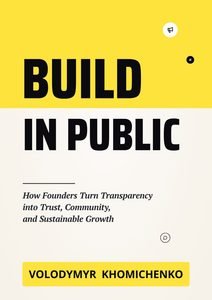
Ebook · ISBN 9798237369052
Amazon Kindle · Kobo · IBS · Casa del Libro
Print · paperback · ISBN 9798237528558
Books-A-Million · ThriftBooks · AbeBooks · Feltrinelli
Audiobook · ISBN 9780466093686
Kobo · Feltrinelli · IBS
Free audio edition
You can listen to a substantial portion of the book for free—approximately 40–50% of it in audio format. This gives you a chance to understand what the book is about before you buy it.
If you’d like to continue, you can purchase your preferred format using one of the links above.
More places to try the free audio edition: ElevenReader · YouTube · Spotify
More about the book:
There is a question behind every founder who builds in public that almost no one asks. Not “What should I share?” That gets asked constantly. The question is, when everything has been shared, what has the openness actually built?
For some founders, the answer is almost nothing. They publish revenue, document decisions, share failures, and attract an audience that never becomes a business. For others, the same transparency creates trust, brings customers, builds a community, and compounds over years. And for a few, openness makes things worse—exposing weaknesses, amplifying mistakes, or turning an audience against the company.
This book studies 40 founders and companies—Buffer, GitLab, Zerodha, Balsamiq, Ghost, Wistia, Baremetrics, Gumroad, Lovable, Replit, and others—to answer one question: why does building in public become an engine of growth for some, do almost nothing for others, and actively harm a few?
The answer is not how much you share, how often you post, or how large your audience becomes. It is what transparency multiplies. Underneath the 40 cases sits a single model: Base × Coefficient × Sign.
The model
- The Base—the viable business underneath the visibility, built on four requirements that transparency cannot create for you
- The Coefficient—the multiplying effect of openness, which strengthens what already exists rather than generating value from nothing
- The Sign—the difference between transparency that helps a business grow and transparency that accelerates its decline
- The Two Gates—substance and truth, the conditions that determine whether openness can work at all
- The Three Amplifiers—openness built into the product, distribution accumulated over time, and honesty that costs the founder something
- The Limits—when to stop sharing, why adoption is not revenue, and what happens when the founder becomes the company’s primary channel
A practical playbook shows how to apply the model. Seven recurring failure patterns explain where founders go wrong. An audit helps determine whether a business is ready to build in public—and what should remain private.
The book also examines the personal cost of constant visibility, the difference between an audience and a community, and why a founder’s reputation can outlive the company they built.
This is not another guide to posting progress updates or publishing revenue dashboards. It is an independent analysis of what makes transparency valuable, what makes it dangerous, and why openness can never replace a business worth building.
Transparency is not an engine. It is a multiplier—and what it multiplies is whatever you have actually built.
Details
| Author | Volodymyr Khomichenko |
| Publisher | Volodymyr Khomichenko (independently published) |
| Publication date | 15 September 2026 |
| Language | English |
| Print length | 202 pages |
| ISBN-13 | 979-8237528558 |
| Series | The Public Influence (Book 1) |
| Formats | Kindle, ebook, paperback, hardcover, audiobook |
An independent analysis based on publicly available information. Not sponsored by or affiliated with the companies discussed.