
Quarterly priorities have been the difference between marketing teams that merely stay busy and those that consistently deliver breakthrough results. In my years as Senior Marketing Director at Zoolatech, I’ve seen too many ambitious plans dissolve into scattered activity. The secret lies in treating your most important goals as Rocks — non-negotiable commitments for the next 90 days.
This approach, drawn from proven execution frameworks, forces clarity and ownership. Instead of vague aspirations, you create concrete deliverables that align teams and drive measurable progress. As someone who has scaled offshore dedicated teams and led high-stakes campaigns, I can tell you that without disciplined quarterly priorities, even the best strategies remain wishful thinking.
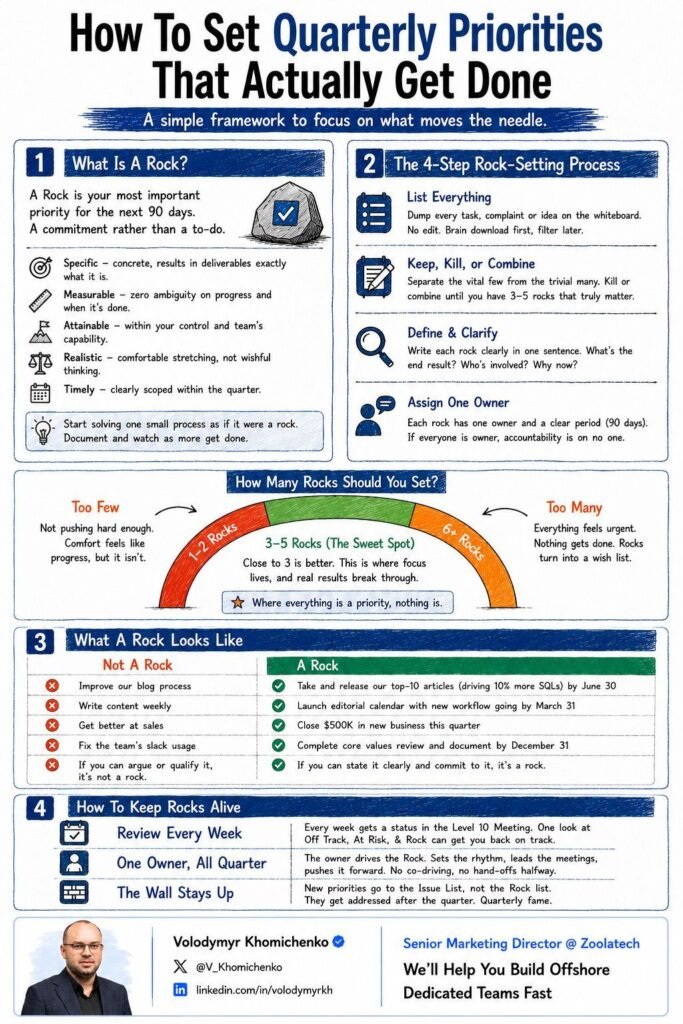
The infographic I analyzed captures this framework perfectly. It emphasizes focus, accountability, and rhythm — elements I’ve applied repeatedly in fast-paced marketing environments. Let’s break it down with the strategic depth it deserves.
What Is A Rock?
A Rock is your most important priority for the next 90 days. It’s a commitment rather than a simple to-do item. This distinction matters deeply. To-dos live in endless lists; Rocks demand completion and ownership.
In practice, effective Rocks follow the SMART criteria but with marketing-specific nuance. They must be:
- Specific — concrete results in clear deliverables.
- Measurable — zero ambiguity on progress and completion.
- Attainable — within your team’s control and capability.
- Realistic — a comfortable stretch, not fantasy.
- Timely — scoped tightly within the quarter.
One pattern I’ve observed across campaigns is that teams who start small, treating even minor processes as Rocks, build momentum. Documenting early wins creates proof that the system works, encouraging broader adoption. In my leadership experience, this psychological shift from overwhelm to focused execution is transformative.
The 4-Step Rock-Setting Process
Setting quarterly priorities isn’t guesswork. It follows a disciplined 4-step process that I’ve refined through multiple fiscal cycles.
First, list everything. Dump every task, complaint, idea, and initiative onto a digital or physical whiteboard. No editing yet — brain dump freely. This step reveals the true scope of noise competing for attention.
Second, keep, kill, or combine. Ruthlessly separate the vital few from the trivial many. In marketing, this often means killing “nice-to-have” content projects that don’t directly impact pipeline or retention. I’ve killed entire campaign themes when they failed this filter, saving teams from distraction.
Third, define and clarify. Write each Rock in one clear sentence. Answer: What’s the exact end result? Who’s involved? Why now? Clarity here prevents scope creep later.
Fourth, assign one owner. Shared responsibility equals no responsibility. Each Rock needs a single driver who sets the rhythm, leads check-ins, and pushes through obstacles. In my experience, this ownership model accelerates velocity dramatically.
This process has repeatedly helped my teams at Zoolatech maintain focus amid rapid growth and client demands.
How Many Rocks Should You Set?
Balance is critical. The sweet spot sits at 3-5 Rocks per quarter.
Too few (1-2) and you’re not pushing hard enough — comfort masquerades as progress. Too many (6+) and everything feels urgent, nothing gets traction, and Rocks devolve into a wish list.
I’ve consistently seen teams thrive closest to three Rocks. This is where real focus lives and results break through. The infographic nails it: “Where everything is a priority, nothing is.”
In marketing leadership, this forces tough choices. Will you prioritize launching a new lead-gen campaign, overhauling content workflow, or closing key partnerships? The limit creates strategic tension that sharpens decision-making.
What A Rock Looks Like
Distinguishing a true Rock from vague goals is an art I’ve honed over years.
Not a Rock: “Improve our blog process” — too fuzzy, unmeasurable. A Rock: “Take and release our top-10 articles (driving 10% more SQLs) by June 30.”
Not a Rock: “Write content weekly.” A Rock: “Launch editorial calendar with new workflow going by March 31.”
The pattern is clear. Strong quarterly priorities state the outcome, include metrics, set deadlines, and imply accountability. If you can argue about it or qualify it endlessly, it’s not a Rock.
In one campaign I led, we set a Rock around closing $500K in new business. The specificity forced sales-marketing alignment and weekly pipeline reviews. We hit the number because the Rock left no room for interpretation.
How To Keep Rocks Alive
Setting quarterly priorities is easy. Keeping them alive separates high-performing teams from the rest.
Review every week. In our Level 10 meetings, one glance at Off Track, At Risk, or On Rock status gets everyone back on course. These short, focused sessions prevent drift.
One owner, all quarter. The owner drives momentum. No hand-offs or co-driving. They own the rhythm.
The wall stays up. New priorities go to an Issue List, not the Rock list. They wait until next quarter. This protects focus and prevents “priority whiplash” — a common killer of marketing execution.
I’ve watched teams derail promising initiatives by constantly adding “urgent” items. Protecting the Rocks creates space for deep work and real outcomes.
Strategic Insights from the Trenches
Looking back at multiple quarters of applying this Rocks framework, several patterns emerge that go beyond the infographic’s basics.
First, consumer and stakeholder behavior rewards consistency. When teams visibly commit to and deliver on quarterly priorities, internal confidence rises and external perception strengthens. Clients and leadership notice momentum.
Second, in marketing specifically, Rocks work best when tied to revenue or growth metrics. Pure activity Rocks — like “post more on social” — rarely move needles. Outcome-focused ones do.
Third, technology and tools matter less than discipline. We’ve used simple whiteboards, project management software, and shared dashboards. The tool is secondary to the weekly review rhythm.
I’ve also observed audience psychology at play. Teams respond to visible progress. Celebrating Rock completions reinforces the behavior. In one instance, completing three key quarterly priorities early created a surge of energy that carried into the next cycle.
Market patterns show that companies maintaining this discipline weather uncertainty better. When economic conditions tighten, clear quarterly priorities help marketing allocate limited resources where they compound.
Common Pitfalls and How to Avoid Them
Even experienced leaders stumble. Here are observations from real scenarios:
- The perfection trap: Teams spend too long defining Rocks. Start imperfectly and refine weekly.
- Ignoring cross-functional dependencies: Involve other departments early. My best Rocks often required sales or product alignment from day one.
- Forgetting documentation: Track what worked and what didn’t. These become institutional knowledge for future quarters.
- Losing the human element: While processes matter, motivation comes from seeing impact. Connect Rocks to broader company vision.
In my executive experience, the teams that treat quarterly priorities as living commitments rather than static lists achieve sustainable growth.
Conclusion
Mastering quarterly priorities through the Rocks framework has been one of the highest-leverage practices in my marketing leadership journey. It transforms vague ambition into executable commitments that deliver results quarter after quarter.
As you implement this, remember: focus is a muscle. The more you protect your 3-5 Rocks, the stronger your team’s execution becomes. In today’s competitive landscape, especially for companies building offshore capabilities or scaling marketing engines, this discipline creates unfair advantage.
The framework in the infographic isn’t theoretical — it’s battle-tested. Apply it thoughtfully, review relentlessly, and watch how your marketing efforts shift from activity to genuine impact. The teams that master this don’t just meet goals; they redefine what’s possible in each 90-day sprint.