
I’ve watched too many smart marketers get lazy the moment AI entered the workflow.
They generate a draft, skim it, hit publish. Then wonder why engagement drops.
Reviewing AI output isn’t optional anymore. It’s the actual job now.
Why Reviewing AI Output Matters More Than Writing It
Here’s something I learned managing content teams for over a decade: the writing was never the hard part. Judgment is.
AI changed who produces the first draft. It didn’t change who’s accountable for the final one.
That’s still you. That’s still your team. That’s still your name on the byline.
When I review AI output with my team, I treat it like editing a junior writer’s first pass. Talented, fast, occasionally brilliant — and frequently wrong in ways that aren’t obvious at first glance.
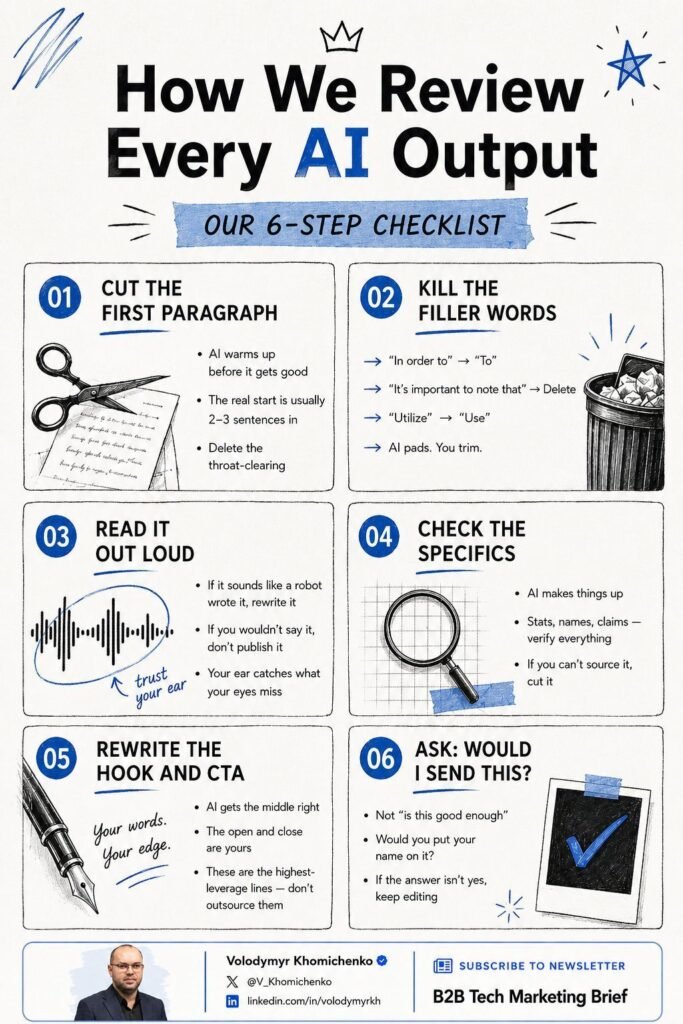
Step One: Cut the First Paragraph
AI warms up before it gets good. Almost every time.
The real content usually starts two or three sentences in. Everything before that is throat-clearing.
I’ve cut hundreds of opening paragraphs this way. Nobody ever missed them.
This matters strategically, too. Your reader’s attention span at the top of an article is the most valuable real estate you own. Wasting it on a warm-up sentence is a cost most brands can’t afford in a feed where someone scrolls past in under two seconds.
Step Two: Kill the Filler Words
“In order to” becomes “to.” “Utilize” becomes “use.” “It’s important to note that” becomes nothing at all.
AI pads sentences because padding sounds safe. Trimming takes confidence — confidence in the idea standing on its own.
I tell younger marketers on my team: if a sentence survives without a word, that word didn’t belong. This single habit improves clarity faster than almost any other edit I make.
Step Three: Read It Out Loud
This is the step people skip, and it’s the one that catches the most.
If a paragraph sounds robotic out loud, it reads robotic on the page. Your ear catches rhythm problems your eyes glide right past.
I learned this the hard way early in my career, long before AI was part of any workflow. Reading copy aloud was how we caught awkward phrasing in print ads before they went to press. The principle hasn’t aged. If you wouldn’t say it in a meeting, don’t publish it in an article.
Step Four: Check the Specifics
This is where I get strict, no exceptions.
AI makes things up. Names, statistics, claims, dates — anything specific is a risk until verified.
I’ve seen confident, well-written paragraphs cite numbers that simply don’t exist. The writing quality has nothing to do with accuracy. Those are two separate problems, and AI only solves one of them.
If you can’t source it, cut it. That rule alone has saved me from publishing corrections more than once.
Why This Step Is Non-Negotiable for B2B Brands
In B2B marketing specifically, credibility is the entire product. Buyers research extensively before talking to sales.
One fabricated statistic in a blog post can undo months of trust-building. I’d rather publish a shorter article with verified claims than a longer one padded with invented authority.
Step Five: Rewrite the Hook and CTA
AI is genuinely good at the middle of a piece. Structure, transitions, logical flow — it handles all of that competently.
The open and the close are different. Those are the highest-leverage lines in any piece of content, and they deserve a human’s instinct, not a model’s average.
Your hook decides whether someone keeps reading. Your CTA decides whether the read turns into action. I never outsource either one, regardless of how good the draft is otherwise.
This is also where brand voice actually lives. The middle of an article can sound generic and still work. The opening and closing lines are where personality either shows up or doesn’t.
Step Six: Ask Yourself, Would I Send This?
Not “is this good enough.” That’s a low bar, and it’s the wrong question entirely.
Would you put your name on it? Would you send it to a client, a board member, your toughest critic?
If the honest answer isn’t yes, keep editing. I use this test on every piece my team produces, AI-assisted or not. It’s blunt, but it works.
What This Process Actually Protects
People think editing AI output is about catching errors. It’s really about protecting positioning.
Every brand competes on trust now, especially in crowded B2B categories where buyers can’t easily tell vendors apart. Sloppy, unverified, robotic-sounding content erodes that trust quietly, one piece at a time.
A six-step checklist sounds simple. It is simple. Simple doesn’t mean optional, and it definitely doesn’t mean fast — discipline rarely is.
I’d rather ship one verified, sharp, human-edited piece a week than five mediocre ones that technically went out faster. Speed without judgment isn’t a strategy. It’s just exposure.