
Most outbound programs fail quietly. Not because the product is wrong. Not because the market is bad. They fail because someone skipped the fundamentals and hoped volume would cover the gaps.
Outbound success is a system. Every part of it matters. Pull on one lever and ignore the others, and you’ll get inconsistent results at best — a damaged sender reputation and a dead pipeline at worst.
Here are nine drivers that separate teams who generate real pipeline from those who just send emails.
Outbound Success Starts Before You Hit Send
Your email can’t convert if it never arrives. Deliverability is the unglamorous gatekeeper of the entire operation.
SPF, DKIM, DMARC — these aren’t IT checkboxes. They’re the difference between your message landing in a primary inbox or disappearing into spam. I’ve seen teams spend weeks crafting perfect messaging only to wonder why reply rates are near zero. Nine times out of ten, it’s a technical setup they never audited.
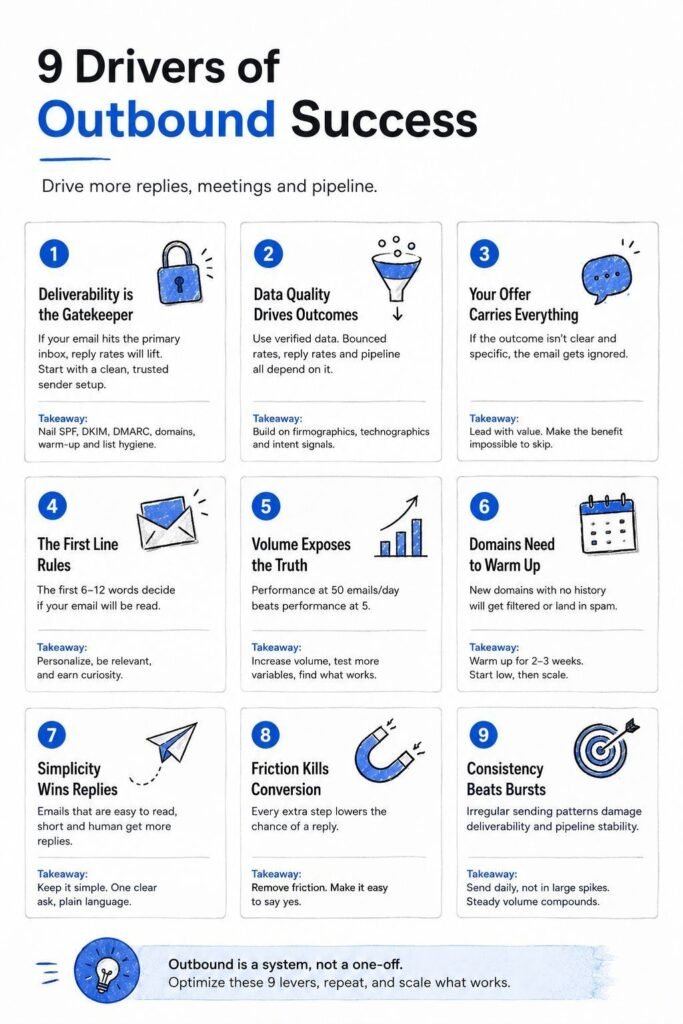
Clean your list. Maintain your sender reputation. Treat deliverability as an ongoing discipline, not a one-time fix.
Data Quality Drives Outbound Outcomes
Bad data is a tax you pay on every campaign. High bounce rates don’t just waste budget — they actively destroy your sender score.
Firmographic and technographic data, layered with intent signals, changes everything. You stop guessing and start reaching companies that are actually in-market. That shift alone can double reply rates without changing a single word of copy.
Verified data isn’t a luxury. It’s the baseline for running a credible outbound operation.
Your Offer Carries the Entire Email
If a prospect reads your email and can’t immediately answer “what’s in it for me?” — you’ve lost them. There’s no second chance at that moment.
Vague value propositions are the most common mistake I see in outbound reviews. Teams write about features, processes, and company history when the only thing the recipient cares about is their own outcome. Lead with the benefit. Make it specific. Make it impossible to ignore.
The strongest offers name a real problem and promise a concrete result.
Six to Twelve Words That Decide Everything
Most emails are judged before they’re opened — and judged again in the first two seconds of reading. The first line is where your email either earns attention or dies.
Generic openers kill curiosity. Personalization builds it. Referencing something real about the company, the role, or the moment in time signals that this isn’t a mass blast. That signal matters more than people realize.
Write the first line last. Make it earn its place.
Outbound Success Requires Enough Data to Learn From
Sending five emails a day doesn’t tell you anything. You can’t optimize what you can’t measure, and you can’t measure what you haven’t tested at scale.
Fifty emails per day begins to produce signal. You start seeing which subject lines pull, which value propositions land, which segments respond. Testing at low volume gives you false confidence. Scaling before you’ve found what works burns your list.
The right sequence: build a system, test at meaningful volume, then scale what’s proven.
Domain Warm-Up Is Not Optional
Sending from a cold domain with no history is one of the fastest ways to kill an outbound program before it starts. Inbox providers don’t trust new senders. It’s that simple.
A two-to-three week warm-up period — starting low, gradually increasing — builds the engagement history that email infrastructure requires. Skipping this step is like opening a new credit account and immediately maxing it out. The system flags you, and recovery takes months.
Build the domain before you need it. Always.
Simplicity Wins More Outbound Replies
The more you ask, the less you get. A long email with multiple asks, dense paragraphs, and corporate language is exhausting to read. Most people don’t bother.
Short. Human. One clear ask. That’s the formula that outperforms almost every alternative I’ve tested. Emails that read like they were written by a real person — not a content team — consistently earn more replies.
Resist the urge to explain everything. Give them just enough to want the conversation.
Friction Kills Conversion at Every Stage
There’s a direct relationship between the number of steps required to respond and the likelihood of a response. Every layer of friction — a long form, a confusing CTA, a link that requires login — lowers your conversion rate.
Make it easy to say yes. A single, low-commitment ask outperforms a detailed multi-step proposal every time in cold outreach. Book a call. Reply with a word. That’s it.
The simpler the path forward, the more people take it.
Outbound Success Is Built on Steady Execution
Irregular sending patterns damage more than just your open rates. They signal unpredictability to inbox providers and create pipeline gaps that are genuinely difficult to recover from.
A steady daily volume — even modest — compounds over time. The teams I’ve seen build the most durable outbound engines aren’t the ones who ran massive campaigns twice a quarter. They’re the ones who sent every single day, optimized continuously, and let the system do its work.
Outbound isn’t a launch. It’s a discipline. The teams who treat it that way are the ones still generating pipeline while everyone else is starting over.