
In my fifteen-plus years steering marketing teams through everything from startup scrambles to enterprise-scale transformations, I’ve learned one truth that cuts through every KPI dashboard and campaign postmortem: what you believe about your own abilities shapes everything you build. Not strategy decks. Not budget allocations. Not even the latest MarTech stack. It’s mindset.
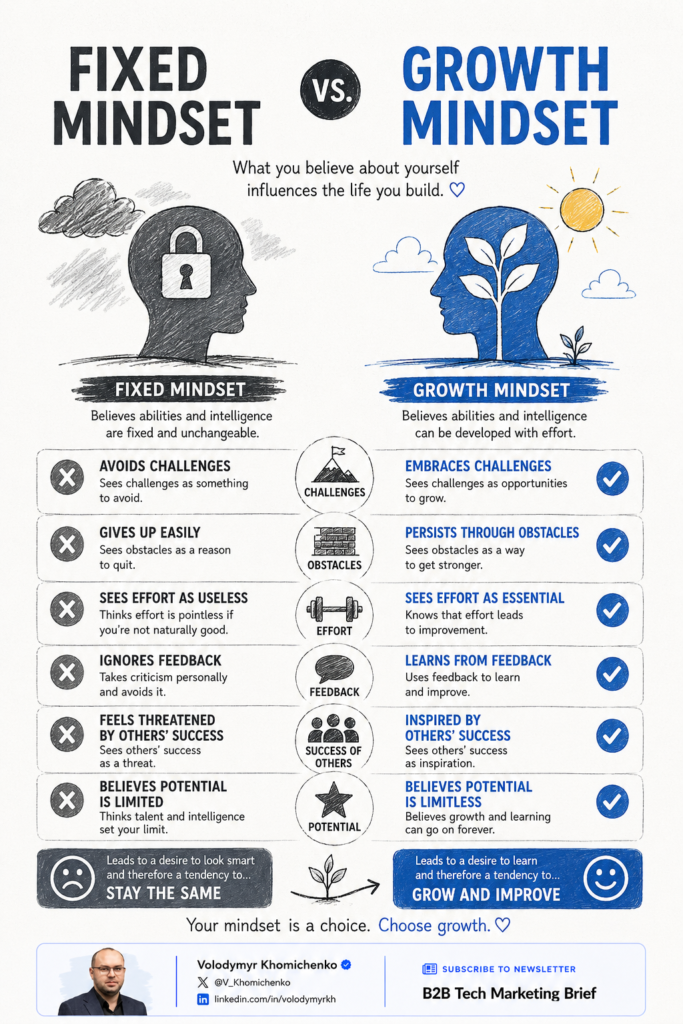
The infographic that crossed my desk recently captured this perfectly — Fixed Mindset versus Growth Mindset. One side locked behind a padlock, the other sprouting new growth under open sky. It’s not psychology 101. It’s a mirror for every marketing leader who has ever watched a campaign flatline or a team member flourish under pressure.
What you believe about yourself influences the life — and the brand — you build. In marketing, where consumer behavior shifts weekly and platforms evolve overnight, that belief becomes the difference between stagnation and sustained relevance. I’ve seen fixed-mindset leaders treat every market challenge as a threat to their personal brand. I’ve watched growth-minded teams treat the same turbulence as raw material for reinvention. The gap isn’t talent. It’s orientation.
The Fixed Trap: Why So Many Marketing Organizations Stay Stuck
Avoiding Challenges That Could Define Your Brand
Fixed-mindset thinking shows up early in marketing careers. I remember a talented campaign manager who consistently sidestepped any brief involving emerging platforms. “We’re not a TikTok brand,” he’d say, as if the label were permanent. The result? While competitors tested, learned, and iterated, we watched market share erode in demographics we once owned.
Challenges in marketing are rarely optional. Algorithm changes, shifting privacy regulations, or sudden cultural moments aren’t inconveniences — they’re the arena where relevance is won or lost. Leaders with fixed mindsets see these as threats to their carefully cultivated expertise. They avoid them. Teams follow suit. The brand stays safe. Safe, unfortunately, often means invisible.
The Effort Paradox in Creative Industries
One of the more insidious fixed-mindset markers is the belief that effort signals lack of natural talent. In marketing, this manifests as the “it should just work” syndrome. I’ve sat in reviews where a team dismissed A/B test results because “good creative shouldn’t need this many iterations.” The subtext: if we were truly talented, the first version would have crushed it.
This mindset kills iteration culture — the very heartbeat of modern performance marketing. Growth-minded practitioners understand that effort compounds. Every test, every failed headline, every pivot based on heatmaps builds institutional muscle memory. The brands winning today aren’t necessarily more creative. They’re more relentless in refining what creativity actually delivers in market.
Feedback as Threat Instead of Fuel
Marketing lives and dies on feedback. Customer research, sentiment analysis, sales team debriefs, creative critiques — these are daily realities. Yet fixed-mindset professionals take criticism personally. I’ve witnessed senior directors bristle at campaign debriefs, framing every insight as an attack rather than data.
The cost is isolation. Teams stop sharing bad news. Agencies sugarcoat reports. The brand drifts while leadership believes everything is fine. In contrast, growth-oriented marketers treat feedback as the most valuable input they receive. They dissect it, contextualize it, and convert it into sharper positioning and more resonant messaging.
The Success of Others: Inspiration or Intimidation?
Perhaps nowhere is mindset more visible than in how marketing leaders respond to competitors’ wins. Fixed thinking breeds defensiveness. “They got lucky.” “Their budget was bigger.” “That won’t work in our category.” The energy goes into rationalizing rather than dissecting.
Growth-minded leaders do the opposite. They study the winner’s playbook with genuine curiosity. What consumer insight did they unlock? How did they sequence their touchpoints? What tension did they resolve in the customer journey? This isn’t imitation — it’s accelerated learning. In my experience, the fastest-growing brands I’ve advised had leadership teams that actively celebrated smart moves by others. It kept them humble and hungry.
Building Growth-Mindset Marketing Teams
Cultivating Persistence Through Real Obstacles
Marketing today is obstacle-rich by design. Budget cuts, platform deprecation, creative fatigue, talent shortages — the list evolves but never empties. Fixed teams see these as reasons to scale back ambition. Growth teams see them as prompts to get sharper.
I once led a rebrand during significant organizational restructuring. Deadlines compressed, stakeholders multiplied, and external factors shifted daily. The fixed thinkers on the team pushed for simpler, safer executions. The growth thinkers asked better questions: How do we turn constraint into distinctiveness? That campaign became one of the most awarded and effective of my career — not despite the obstacles, but because we chose to engage them fully.
Redefining Effort as the Ultimate Differentiator
In an industry obsessed with “genius” creative and viral moments, it’s easy to undervalue consistent effort. Yet the brands with the strongest compound growth curves are usually the ones that treat marketing as a disciplined practice rather than sporadic inspiration.
This means embracing the unglamorous work: mapping customer decision journeys at granular levels, maintaining testing cadences even when results are incremental, documenting learnings so institutional knowledge survives team turnover. Growth mindset reframes this grind as the path to mastery. Fixed mindset sees it as admission that you’re not good enough yet.
Feedback Systems That Actually Drive Improvement
The most effective marketing organizations I’ve built or advised treat feedback as infrastructure, not afterthought. Regular win/loss analyses, structured creative reviews, cross-functional retrospectives — these become rituals rather than events.
Crucially, growth-minded leaders model vulnerability. When I publicly acknowledge a misread on audience sentiment or a campaign that missed its mark, it gives permission for the entire team to learn openly. Psychological safety isn’t soft. In marketing, it’s a performance multiplier.
Harnessing Collective Potential
One of the most powerful shifts happens when teams move from believing talent is fixed to understanding potential is limitless. This changes hiring, development, and promotion conversations dramatically.
Instead of looking for “natural marketers,” we seek learners who demonstrate adaptability. We invest in stretch assignments that force skill expansion. We celebrate progress as much as outcomes. The result is organizations that scale capability faster than competitors can copy tactics.
Strategic Implications for Brand Leadership
From Static Positioning to Adaptive Advantage
Brands, like people, can operate with fixed or growth orientations. Fixed brands cling to heritage claims and legacy positioning even as markets evolve. Growth brands continuously expand their understanding of what they can become.
Consider how some legacy B2B players have successfully pivoted into thought leadership ecosystems or how consumer brands have moved from product features to cultural relevance. These weren’t one-off campaigns. They were manifestations of organizational belief that capabilities can be developed — that relevance is earned through evolution, not inherited.
Consumer Psychology in a Growth-Mindset World
Modern consumers increasingly reward brands that demonstrate growth. They sense authenticity in brands willing to learn publicly, admit missteps, and iterate visibly. The brands building deepest emotional connections aren’t those projecting perfection. They’re the ones showing progress.
This has profound implications for storytelling. Growth-mindset marketing moves beyond polished case studies to honest journeys — complete with setbacks, pivots, and earned insights. These narratives resonate because they mirror how real people experience growth.
The Long Game of Talent and Culture
In tight talent markets, mindset becomes a retention and attraction factor. Growth-oriented professionals gravitate toward environments where learning is celebrated and potential is nurtured. Fixed cultures quietly lose their best people to organizations that better match their developmental drive.
As Senior Marketing Director, I now evaluate team health partly through this lens. Are we attracting people who want to get better, or those who want to look good? The difference compounds over quarters and years.
Conclusion
Your mindset is a choice. Choose growth.
After years in the trenches of brand building, competitive battles, and organizational change, I’m convinced that technical skills and creative talent matter — but they’re table stakes. The real differentiator is whether you and your teams believe abilities can be developed through effort, feedback, and persistence.
The marketing leaders and brands that will thrive in the next decade won’t necessarily be the ones with the biggest budgets or the flashiest ideas. They’ll be the ones who treat every challenge as a growth vector, every obstacle as training, and every insight — positive or negative — as fuel for the next iteration.
In a world of constant disruption, fixed mindset is the ultimate luxury no serious marketer can afford. Growth mindset isn’t just personally liberating. It’s strategically essential.
The question isn’t whether you have talent. It’s whether you’re willing to keep developing it. The brands and leaders making that choice are already pulling ahead. The rest are watching from behind the padlock.
Choose growth. The market will notice.