
In my fifteen years steering marketing teams—first in fast-growth startups and now as senior marketing director at Zoolatech, where we build dedicated offshore teams for ambitious brands—I’ve watched entire playbooks get rewritten every couple of years. What worked in 2018 feels quaint today. By 2030, the difference between brands that dominate and those that fade won’t be budget size or flashy tech stacks. It will come down to people who possess a precise blend of cognitive sharpness, human depth, and adaptive fluency.
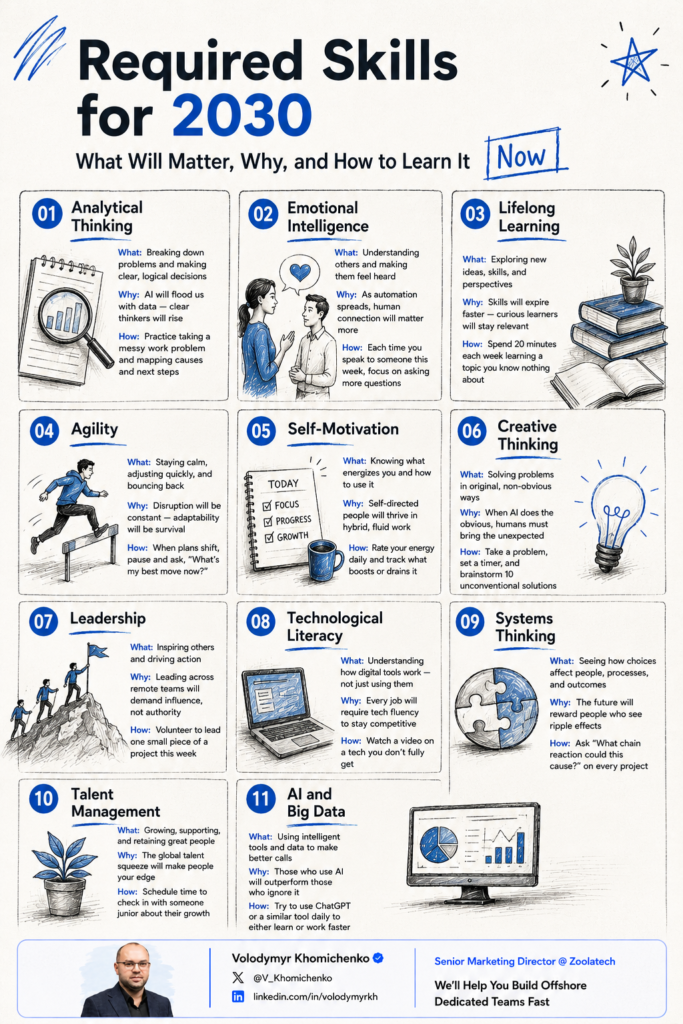
That’s why I created the infographic “Required Skills for 2030.” It distills eleven capabilities that I’m actively hiring for, developing in my current team, and sharpening in my own practice. These aren’t abstract academic ideals. They’re battle-tested differentiators I’ve seen separate high-performing campaigns from mediocre ones and resilient organizations from fragile ones. AI will handle the routine. Markets will punish rigidity. Consumers will reward authenticity at scale. The leaders who thrive will be those who treat these skills as daily disciplines rather than checklist items.
What follows isn’t theory. It’s the strategic lens I apply when evaluating talent, shaping campaign strategy, and guiding our offshore delivery model. Let’s break it down.
Cognitive Foundations for Complex Decision-Making
Analytical Thinking
Every quarter I sit with performance dashboards that now generate more data points than a human could manually review in a lifetime. The skill that consistently separates strong marketers from average ones is the ability to cut through that noise—breaking complex problems into clear, logical components and making decisions that actually move the needle.
In my experience, AI will only accelerate the data flood. What rise above it are thinkers who can map messy campaign realities, identify root causes, and define next steps with precision. I’ve watched teams waste six-figure budgets chasing vanity metrics because they never truly dissected the customer journey. The antidote? Forcing ourselves to take one chaotic work problem each week, diagram the causes, and commit to the three highest-leverage actions. In marketing terms, that’s the difference between a campaign that “feels right” and one that compounds ROI month after month.
Creative Thinking
AI is already writing headlines and generating first drafts faster than any junior copywriter. What it cannot do—yet—is deliver the non-obvious insight that stops a scroll and builds genuine emotional connection. Creative thinking, for me, means solving marketing problems in original ways when the obvious answer has already been automated.
I’ve run enough A/B tests to know that the biggest lifts rarely come from incremental tweaks. They come from the 10-minute brainstorms where we deliberately set aside the safe route and force unconventional angles. In practice, this looks like giving a team a real business challenge, a timer, and permission to explore ten wild solutions before converging on the strongest. The brands that win in 2030 won’t outspend; they’ll out-imagine.
Systems Thinking
Marketing no longer operates in silos. A single paid social post can ripple into customer support tickets, product feedback, sales pipelines, and brand reputation. Systems thinking is the discipline of seeing those interconnections before they become crises or opportunities.
In our offshore model at Zolatech, I constantly ask teams: “What chain reaction could this decision trigger across the client’s entire funnel?” The marketers who grasp ripple effects design campaigns that align sales, product, and customer success instead of creating hidden friction. This skill turns good executors into strategic partners—and in a world of integrated martech stacks, it’s becoming table stakes.
The Human Edge in an Automated World
Emotional Intelligence
Automation is handling the transactional side of marketing. What remains irreplaceable is the ability to read the room—whether that room is a customer focus group, a cross-functional Slack channel, or a client review meeting. Emotional intelligence has always mattered; in hybrid and remote environments, it has become a superpower.
I’ve seen campaigns tank not because the creative was weak but because the team never truly understood how the target audience felt about the category. Conversely, the most memorable brand moments I’ve been part of came from leaders who paused to ask deeper questions and actually listened to the answers. Practically, I encourage every direct report to treat every conversation as an opportunity to ask one more question than they answer. It builds empathy muscles and surfaces insights no dashboard can show.
Self-Motivation
In marketing, the pace never slows. There’s always another campaign launch, another algorithm update, another competitive threat. The professionals who sustain performance over years are those who know exactly what energizes them and what drains them—and who actively manage their own energy.
I track my own daily energy patterns and encourage my team to do the same. It’s not fluffy self-help; it’s operational intelligence. When self-directed people thrive in fluid environments, they don’t wait for external motivation. They become the engine. In practice, I’ve seen this translate directly into higher campaign velocity and lower burnout rates—critical advantages when competing for global talent.
Agility
Disruption isn’t a quarterly event anymore; it’s the new baseline. Algorithm changes, geopolitical shifts, sudden consumer sentiment swings—any one of these can render a quarter’s strategy obsolete overnight. Agility is the practiced ability to stay calm, reassess, and move forward without losing momentum.
In my leadership practice, I’ve made it a ritual: when a plan shifts, we pause for sixty seconds and ask, “What’s my best move now?” That micro-habit has saved more campaigns than any contingency plan I’ve ever written. For marketing teams operating across time zones with offshore partners, agility isn’t optional—it’s how we deliver speed without sacrificing quality.
Lifelong Learning
The half-life of marketing skills is now measured in months, not years. Platforms evolve, consumer behaviors pivot, and yesterday’s best practice becomes today’s cautionary tale. Lifelong learners aren’t just staying relevant—they’re creating the next standard.
I block twenty minutes every single day to explore a topic I know nothing about. Sometimes it’s a new AI tool, sometimes a behavioral science paper, sometimes a competitor’s latest move. That deliberate curiosity compounds. It’s why our team at Zolatech can pivot faster than organizations twice our size. Skills expire; the habit of learning does not.
Leadership, Talent, and Tech Fluency for High-Performance Teams
Leadership
Authority is an outdated concept in modern marketing organizations. Real leadership today is about inspiring action and driving momentum across distributed, often remote teams where influence must be earned daily.
At Zolatech, we routinely lead cross-continental marketing squads. The leaders who succeed aren’t the loudest voices in the room; they’re the ones who paint a clear vision, remove obstacles, and celebrate progress in ways that feel personal. I still volunteer to lead small internal projects myself precisely to stay sharp at this. In 2030, the best marketing organizations will be run by people who understand that culture and clarity beat command-and-control every time.
Talent Management
The global competition for great marketing talent is only intensifying. Those who treat talent development as a core discipline will build moats their competitors cannot cross.
In my role, I schedule recurring one-on-ones focused exclusively on growth—not deliverables. I check in with juniors about their ambitions, pair them with mentors, and create space for them to stretch. It’s not soft HR work; it’s the highest-leverage investment a marketing leader can make. When you grow people, you grow capability, retention, and innovation capacity all at once. In our offshore model, this approach has turned good teams into exceptional ones that clients fight to keep.
Technological Literacy and AI and Big Data
Understanding how digital tools actually work is no longer optional. Every marketing role will demand fluency with the tech layer, not just the output layer. More importantly, the marketers who treat AI and big data as daily copilots will simply outperform everyone else.
I make it a rule: use ChatGPT or an equivalent tool on every project, whether for research, ideation, or analysis. The goal isn’t replacement; it’s amplification. Those who master prompt engineering, interpret data patterns, and combine machine speed with human judgment create hyper-personalized experiences at scale. In practice, this has let our teams move from weeks-long reporting cycles to real-time optimization loops. The competitive gap is widening daily.
Conclusion
Looking ahead to 2030, I’m convinced the marketing function will be smaller in headcount but vastly more impactful—composed of professionals who have deliberately cultivated these eleven capabilities. The technology will keep advancing. The data will keep multiplying. Consumer expectations will keep rising. What won’t change is the premium placed on clear thinking, genuine human connection, relentless adaptability, and the ability to lead and develop others.
As I continue to build high-performing marketing teams and help our clients do the same through dedicated offshore talent, I treat these skills as non-negotiable. Not because some future-of-work report told me to, but because I’ve seen them deliver results in the trenches—higher campaign ROI, stronger team retention, faster time-to-market, and brands that actually matter to people.
The good news? None of these require a PhD or a massive training budget. They require intention, daily practice, and the willingness to look honestly at where we stand today. Start small. Pick one skill this week. Map a messy problem. Ask better questions. Run that 10-minute brainstorm. Schedule that growth conversation.
The future doesn’t belong to the biggest budgets or the latest tools. It belongs to the marketers who decide, right now, to become the kind of leaders 2030 demands. At Zoolatech, that’s exactly what we’re doing—one disciplined habit at a time.