
In my years as senior marketing director steering growth for B2B tech companies, I’ve sat through far too many strategy sessions where the conversation inevitably circles back to the same tired playbook: outspend the competitor on LinkedIn ads, undercut on pricing, or pile on more features to win the same set of enterprise buyers. The exhaustion is palpable. Markets feel saturated, customer acquisition costs climb relentlessly, and differentiation becomes a race to the bottom. That, in a nutshell, is the red ocean—bloody waters where everyone fights over existing demand and the same exhausted prospects.
What I’ve learned, both through campaigns that succeeded spectacularly and others that quietly bled budgets, is that true market leadership rarely comes from competing harder inside those crowded spaces. It comes from stepping outside them entirely. Blue Ocean Strategy, the framework that challenges us to define the market rather than just compete within it, has become one of the most practical tools in my leadership toolkit. It’s not abstract theory; it’s a disciplined way to reframe offerings, uncover underserved demand, and build advantages competitors literally cannot copy.
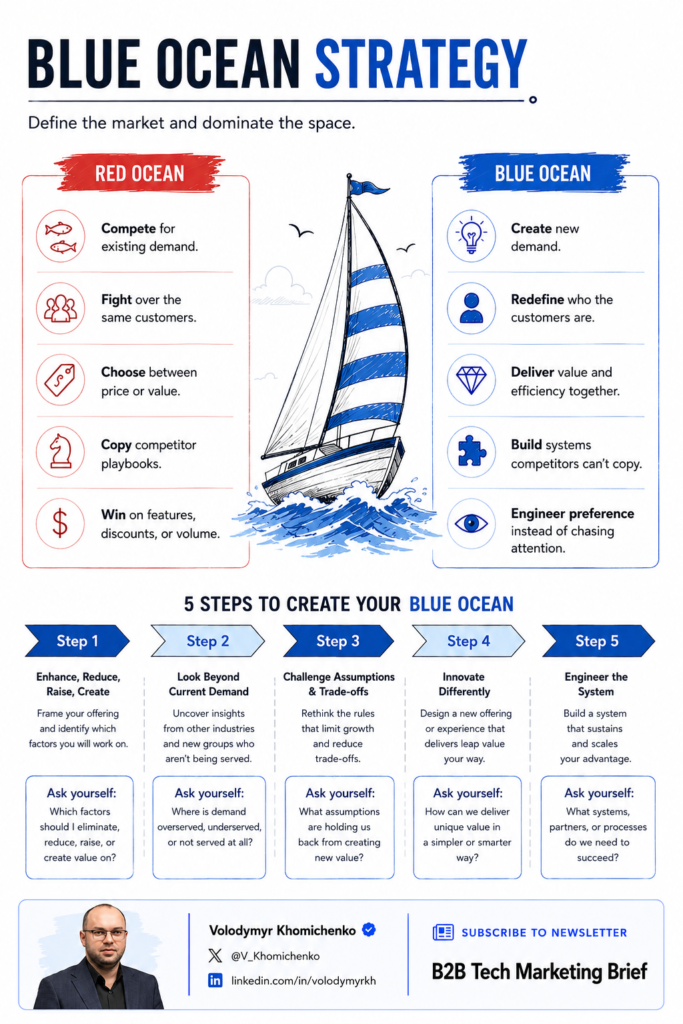
In today’s B2B tech landscape — where AI tools, martech platforms, and collaboration suites multiply by the week — this approach isn’t optional. Buyer attention is fragmented, decision-makers are overwhelmed by near-identical solutions, and traditional growth levers are losing potency. The strategic insight I keep coming back to is simple yet profound: the companies that thrive long-term aren’t the ones that win the feature bake-off. They’re the ones that create new demand where none existed before. This article unpacks exactly how to make that shift, drawing directly from the core contrasts and five-step process that have guided some of the most successful repositionings I’ve led and observed.
The Red Ocean Trap: Where Most B2B Tech Brands Are Stuck Bleeding Resources
The red ocean mindset is seductive because it feels familiar. Every quarter we benchmark against competitors, scan their product roadmaps, and adjust our messaging to match. Yet in my experience leading marketing teams through multiple SaaS cycles, this path consistently produces the same outcomes: commoditization, margin erosion, and buyer fatigue that no amount of clever copy can overcome.
At its core, red ocean competition means fighting for existing demand among the same, well-defined customer segments. In B2B tech, that often translates to the endless battle for mid-market operations leaders or IT procurement teams who already know they need a CRM, a project management tool, or a customer support platform. We fight over the same customers because it’s easier than educating new ones. We force ourselves into price-or-value trade-offs, believing we must choose between premium positioning and aggressive discounting. We copy competitor playbooks — same webinar formats, same case study templates, same ABM sequences — because they worked once for someone else. And we chase wins through features, volume discounts, or sheer scale, hoping one more integration or one more tier will tip the scales.
The business implications are brutal and predictable. Customer acquisition costs spiral while lifetime value stagnates. Audience psychology shifts from excitement to skepticism; decision-makers glaze over when yet another “best-in-class” solution lands in their inbox. I’ve seen martech stacks where five tools perform nearly identical functions, each claiming slight differentiation that buyers simply cannot discern. The result? Longer sales cycles, higher churn risk, and marketing teams burning out on incremental gains that feel more like survival than growth. In one campaign I inherited, we were spending heavily to out-feature a direct rival in the analytics space. Conversion rates plateaued, and win rates hovered around 25%. The lesson was clear: when everyone plays the same game, the only winners are the incumbents with deeper pockets.
Charting the Blue Ocean: Principles That Let You Redefine the Competitive Landscape
Blue ocean thinking flips the script entirely. Instead of competing for existing demand, you create new demand. Instead of fighting over the same customers, you redefine who the customers actually are. The payoff is a space where preference is engineered rather than chased, and systems are built that competitors cannot easily replicate.
What strikes me most in practice is how delivering value and efficiency together becomes possible once you escape the trade-off trap. In B2B tech, this often means moving beyond “better software” to entirely new ways of solving entrenched problems. Think about how certain platforms redefined entire workflows — not by adding more bells and whistles, but by making complex processes feel effortless while delivering measurable ROI faster. You build systems that lock in advantage: proprietary data networks, integrated ecosystems, or customer success loops that feel native rather than bolted on. Most powerfully, you engineer preference by aligning so deeply with intent that buyers don’t even consider alternatives.
I’ve applied this lens across campaigns where we stopped chasing the usual suspects and instead targeted adjacent roles or industries that were underserved. The shift in results was immediate: higher engagement because we weren’t shouting into an already noisy channel, stronger pricing power because the value equation felt unique, and faster scaling because the moat was structural rather than tactical. Consumer behavior observations reinforce this—B2B buyers are humans first; when you remove friction and deliver unexpected relevance, loyalty compounds in ways that feature lists never achieve. The strategic observation here is that blue oceans aren’t about being first to market with a flashy product. They’re about being first to reframe the problem in a way that makes the old solutions obsolete.
The 5-Step Framework to Building Your Own Blue Ocean
Translating vision into execution requires discipline. The five-step process provides exactly that—a repeatable methodology I’ve used to reposition offerings and unlock growth in otherwise mature categories.
Step 1: Enhance, Reduce, Raise, Create — Reframing Your Offering
Begin by systematically evaluating every factor in your value proposition. Which elements should you eliminate because they no longer serve real needs? Which should you reduce to strip out complexity? Which ones deserve to be raised for disproportionate impact? And what entirely new elements can you create that change the conversation? In one SaaS repositioning I led, we eliminated bloated reporting dashboards that customers rarely used, reduced onboarding friction dramatically, raised the level of industry-specific insights, and created a collaborative workspace that didn’t exist in competing tools. The ask-yourself question—”Which factors should I eliminate, reduce, raise, or create value on?”—forces the kind of ruthless prioritization that turns good products into category definers.
Step 2: Look Beyond Current Demand
Next, deliberately look outside your core buyer persona and current industry boundaries. Uncover insights from adjacent sectors or from groups who are overserved, underserved, or not served at all. In B2B tech, this might mean discovering that finance teams in manufacturing are desperate for real-time visibility that traditional ERP systems don’t provide without massive implementation costs. The question “Where is demand overserved, underserved, or not served at all?” has repeatedly surfaced opportunities that traditional segmentation completely misses. I’ve seen teams uncover entirely new use cases by interviewing non-customers and mapping their pain points back to our capabilities.
Step 3: Challenge Assumptions and Trade-offs
Every industry operates under unspoken rules that limit growth— “enterprise software must be complex,” “buyers always want more features,” or “personalization requires massive data infrastructure.” Step three demands you surface and dismantle those assumptions. Rethinking trade-offs is where the real leverage lives. When we challenged the assumption that robust security and user-friendly interfaces were mutually exclusive, we unlocked a blue ocean in a compliance-heavy vertical. The guiding question—”What assumptions are holding us back from creating new value?”—turns strategy sessions from defensive to expansive.
Step 4: Innovate Differently
With assumptions challenged, design a new offering or experience that delivers a leap in value your way. Simplicity often becomes the secret weapon here. The question “How can we deliver unique value in a simpler or smarter way?” pushes teams beyond incrementalism. I’ve watched product and marketing alignment around this principle produce experiences that felt revolutionary precisely because they removed layers rather than added them—think streamlined workflows that collapse what used to require three tools into one intuitive interface.
Step 5: Engineer the System
Finally, build the operational backbone that sustains and scales your advantage. This is where many strategies falter—brilliant ideas without defensible systems become copyable overnight. Identify the partners, processes, and internal capabilities that create a moat. The question “What systems, partners, or processes do we need to succeed?” forces investment decisions that align with the new strategy rather than legacy operations. In practice, this might mean co-developing integrations with complementary platforms or redesigning customer success to embed your solution deeper into client organizations.
Conclusion
Blue Ocean Strategy isn’t a one-time workshop exercise; it’s a leadership mindset that reshapes how we allocate resources, measure success, and ultimately define our role as marketers. In an era where AI is accelerating product parity and buyer skepticism is at an all-time high, the brands that will dominate aren’t those shouting loudest in the red ocean — they’re the ones quietly engineering new oceans of opportunity.
My closing observation after years in the trenches is this: the most satisfying campaigns I’ve led weren’t the ones where we beat the competition on metrics. They were the ones where we made the competition irrelevant by creating demand they weren’t even equipped to serve. As B2B tech marketers, we have both the responsibility and the privilege to stop broadcasting into saturated channels and start architecting markets that didn’t exist yesterday. The framework is here. The only remaining question is whether we have the courage to use it.